

Choosing between Python frameworks boils down to a fundamental trade-off: FastAPI is a modern, high-performance micro-framework built from the ground up for asynchronous APIs and microservices. Django, on the other hand, is an established, "batteries-included" powerhouse perfect for getting full-featured, monolithic web applications off the ground with remarkable speed. The right choice for you hinges on what you value more—raw performance and architectural freedom, or an all-in-one toolkit designed for convention and rapid, full-stack development. This guide will provide the depth needed to make that critical decision.
Choosing Your Python Framework: Modern Speed vs. Established Power
When starting a new project, picking between FastAPI and Django is more than just a simple technical choice. It's a strategic decision that will define how fast you can build, what kind of performance you can expect, and how your application's architecture will evolve over its lifetime. This guide frames the FastAPI vs Django comparison not by asking which one is "better," but by helping you figure out which is the right tool for the job you have in mind. Understanding their core philosophies and where each excels is the first step toward building a successful, scalable application.
Understanding The Core Philosophies
FastAPI has exploded in popularity because of its API-first design and its embrace of modern Python features. It was built for today's web, leveraging type hints and asynchronous programming to squeeze out every drop of performance. Its main advantage is its native support for asynchronous operations, which makes it a phenomenal choice for microservices, real-time applications, and machine learning model endpoints where low latency and high concurrency are non-negotiable. It's lightweight, flexible, and gives developers full control over their technology stack.
Then you have Django, the seasoned veteran that powers massive sites like Instagram and Spotify. Its "batteries-included" approach means it hands you almost everything you need from the start—a powerful Object-Relational Mapper (ORM), a ready-to-use admin panel, built-in authentication, a templating engine, and more. This all-in-one, opinionated structure is meant to get complex, data-driven websites built and launched in record time by providing a clear, conventional path forward. This comprehensive ecosystem minimizes the need to integrate disparate third-party libraries, ensuring a cohesive and secure development experience from day one.
The decision often boils down to a trade-off: Django offers a structured, all-in-one system for building full applications quickly, whereas FastAPI provides the raw performance and flexibility needed for specialized, high-throughput APIs.
Choosing the right technology from the start is crucial. If you'd like to dive deeper into this topic, you can learn more about how to choose your tech stack in our detailed guide. Making an informed choice early on prevents costly re-architecting down the line.
FastAPI vs Django a Quick Comparison
To really grasp where each framework shines, a side-by-side view is helpful. This table offers a high-level summary of the core differences between FastAPI and Django, helping you quickly identify their ideal applications and architectural leanings.
| Attribute | FastAPI | Django |
|---|---|---|
| Primary Use Case | High-performance APIs, microservices, async tasks | Full-stack web applications, CMS, e-commerce |
| Architecture | Asynchronous (ASGI), minimalist, modular | Synchronous (WSGI), monolithic, "batteries-included" |
| Performance | Extremely high, built for speed and concurrency | Good, but slower due to its synchronous core |
| Development Speed | Fast for APIs, but requires adding components | Very fast for full applications due to built-in features |
| Learning Curve | Steeper; requires async and type hint knowledge | More accessible for beginners due to structure |
| Flexibility | High; choose your own components (ORM, etc.) | Opinionated; promotes a specific "Django way" |
| Community & Ecosystem | Growing rapidly, modern and active | Vast, mature, and extensive third-party packages |
This quick look should give you a starting point. Now, let's dive into the specifics to see how these differences play out in the real world, starting with the most significant architectural distinction between them.
The Core Architectural Difference: Sync vs. Async Explained
The single biggest factor in the FastAPI vs. Django debate boils down to how they handle requests. This isn't just a technical footnote; it’s a fundamental design choice that shapes everything from performance and scalability to the kinds of problems each framework solves best. It's really a tale of two different philosophies for getting work done, each with its own set of strengths and ideal use cases.
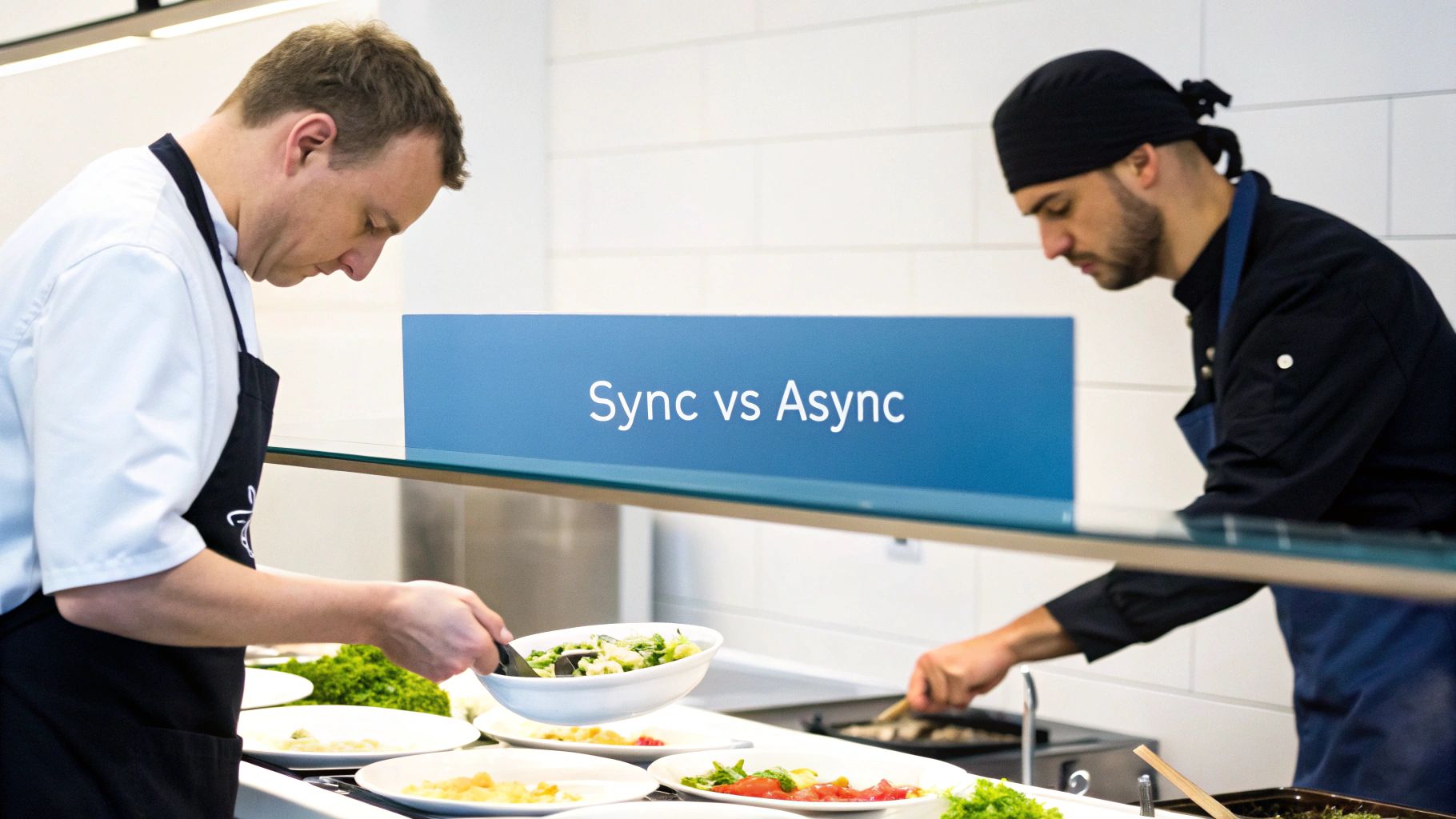
Django was built on the classic synchronous (sync) model, which follows a logical, one-at-a-time execution path. It's easy to follow. Imagine a chef who takes an order, cooks the entire meal from start to finish, serves it, and only then starts on the next ticket. That’s exactly how a traditional sync web server, built on WSGI (Web Server Gateway Interface), operates—it processes one request completely before moving to the next.
This one-at-a-time approach is simple to understand and has been the workhorse of the web for years. For many common applications, like a company blog, a standard e-commerce store, or an internal dashboard, this model is perfectly reliable and often easier to debug. The cracks only start to show when tasks involve a lot of waiting, such as I/O operations like database queries or external API calls.
The Power of Asynchronous Operations
FastAPI, on the other hand, was born in an asynchronous (async) world. Built on modern Python standards like ASGI (Asynchronous Server Gateway Interface), its approach is fundamentally different. Picture a busy, modern kitchen: one chef starts boiling pasta, then immediately pivots to chop vegetables for a different order while the water heats up, all while keeping an eye on a simmering sauce. They're juggling multiple tasks by never sitting idle and efficiently using every moment.
This is precisely how FastAPI manages web requests. When a task requires waiting for something—like querying a database, calling another service, or reading a file—FastAPI doesn't grind to a halt. It simply sets that task aside, yields control, and uses the downtime to work on other incoming requests. Once the waiting task is complete, FastAPI picks it back up where it left off.
By not blocking on I/O operations, an asynchronous framework like FastAPI can handle a significantly higher number of concurrent connections with the same server resources, directly impacting scalability and user experience.
This non-blocking behavior is a game-changer for applications that are I/O-bound, meaning their speed is limited more by waiting for input/output operations to complete than by raw CPU power. This is a common characteristic of modern web backends that interact with databases, microservices, and third-party APIs.
Where Async Truly Shines
The benefits of FastAPI's async-first architecture really come into focus in a few key scenarios. Knowing these is crucial for picking the right tool for your project, as choosing async where it's not needed can add unnecessary complexity.
- High-Concurrency APIs: If you're building a backend that needs to serve thousands of simultaneous users for a mobile app or a busy single-page application, async is what keeps the server from buckling under the load.
- Real-Time Applications: For things like live chat, push notifications, or streaming data dashboards that use WebSockets, an async architecture is practically a requirement to maintain those persistent, low-latency connections efficiently.
- Microservices and External API Calls: When your service needs to talk to other services frequently, a sync model would spend most of its time just waiting for responses. FastAPI can fire off those requests and get other work done in the meantime, which dramatically boosts throughput.
- AI and ML Model Serving: Deploying machine learning models often involves inference requests with unpredictable latency. An async server can handle a new request while waiting for a previous, long-running inference to finish, making much better use of expensive GPU or CPU resources.
While Django has been steadily adding async support for views, middleware, and its ORM, its heart is still synchronous. The ecosystem and core architecture were not built with async as the primary paradigm. FastAPI’s native, async-from-the-ground-up DNA gives it a clear advantage for building the highly responsive and scalable systems that modern applications demand.
Comparing Performance Benchmarks and Real-World Speed

Let's move past the architectural theory and get straight to the numbers, because that’s where the story of the FastAPI vs Django performance gap gets really interesting. Performance isn't just about bragging rights; it directly impacts your user experience, your server costs, and whether your application can handle a sudden surge in traffic. And when it comes to raw speed and throughput, FastAPI was built from day one to be one of the fastest Python frameworks on the planet.
This isn't just marketing hype. Independent benchmarks, like the well-respected tests from TechEmpower, consistently show FastAPI's core components—Starlette for the web toolkit and Uvicorn for the ASGI server—leading the pack for Python frameworks. We're talking about requests per second, the ultimate metric for any app that needs to be quick on its feet and handle significant concurrent load.
The Numbers Behind The Speed
For applications where every millisecond counts—think real-time bidding platforms, live chat services, or an API serving a machine learning model for a high-traffic app—this speed is a non-negotiable advantage. Some benchmarks show FastAPI's underlying stack pushing ~20,000+ requests per second on simple, non-blocking JSON serialization endpoints. That kind of throughput completely eclipses what you’d typically see from a synchronous framework like Django, which often handles a few hundred to a couple of thousand requests per second under similar conditions.
In the real world, its async nature means it can juggle way more simultaneous connections than Django, especially when tasks involve waiting for something else, like a database query to finish or a call to an external API. Check out this breakdown of Python backend frameworks to see how they stack up in various tests.
This efficiency isn't just an abstract concept; it has a direct impact on your bottom line:
- Lower Infrastructure Costs: When you can handle more traffic on the same hardware, you need fewer servers. That means smaller cloud bills, especially as you scale.
- Better User Experience: Fast API responses mean your app feels snappy and responsive, which is critical for keeping users engaged and reducing churn.
- Smarter Scaling: A high-performance base makes it much easier and cheaper to scale your app as your user base grows. You can handle traffic spikes more gracefully without over-provisioning resources.
It's Not Always About Raw Speed
But here’s the thing—you have to look beyond the headline numbers. FastAPI’s incredible speed really comes to life during I/O-bound operations. These are the exact situations its async architecture was designed for. While one request is waiting on the database, FastAPI isn't just sitting there; it's already working on another one.
On the flip side, for CPU-intensive work like crunching complex data, running heavy calculations, or processing large images, the performance gap between FastAPI and Django shrinks significantly. This is largely due to Python's Global Interpreter Lock (GIL), which prevents true multi-core parallelism for a single process. In these scenarios, the framework's overhead matters less than the time it takes to actually do the math, and both frameworks will be similarly constrained.
The key takeaway is that FastAPI's performance is transformative for I/O-heavy workloads, but it's not a silver bullet for CPU-bound computations. The nature of your application's workload is the most important factor in determining which framework will perform better for you.
Django, to its credit, isn't just standing still. The framework is actively improving its async capabilities, introducing features like async views, middleware, and ORM methods. While these are huge steps in the right direction, Django's core is still fundamentally synchronous, and its async support is more of an addition than a native feature. It simply can't match the built-from-the-ground-up async performance of FastAPI for I/O-bound tasks.
For many businesses, Django is plenty fast. But for those operating at the edge of concurrency and low-latency requirements, FastAPI has a clear, undeniable advantage. As you scale, keeping a close eye on your system is key; you might be interested in our guide on application performance monitoring tools to maintain efficiency.
Developer Experience: The All-In-One vs. The Modular Toolkit
Performance benchmarks are one thing, but how a framework feels to work with day in and day out is just as important. This is where the core philosophies of Django and FastAPI really diverge. Making the right choice in the Fastapi vs Django debate here will shape everything from how quickly you can build to how easily your team can collaborate and maintain the codebase long-term.
Django’s claim to fame has always been its "batteries-included" approach. It's a complete, integrated system right out of the box, designed to get you from zero to a full-stack application as quickly as possible. Everything is designed to fit together, enforcing a consistent way of building things. It has a clear opinion on project structure, ORM usage, and security.
For teams, especially larger ones or those with varying skill levels, this opinionated structure can be a godsend. It means everyone is on the same page, using the same tools and following the same conventions. This makes onboarding new developers and keeping the codebase manageable over the long haul much, much simpler.
Django: The All-In-One Powerhouse
Django's built-in components are battle-tested, brilliantly documented, and designed for seamless integration. You can feel this cohesion when you're working with it—it’s a huge productivity boost that eliminates decision fatigue.
- Integrated ORM: The Django ORM is woven into the very fabric of the framework. It lets you interact with your database using Pythonic code, saving you from writing raw SQL and handling schema migrations gracefully.
- Automatic Admin Panel: This is probably Django's most-loved feature. With just a few lines of code, you get a secure, production-ready interface to manage all your application's data, which is invaluable for internal tools and content management.
- Built-in Authentication: It ships with a complete and secure system for handling user accounts, groups, and permissions. This covers a massive and tricky part of web development from the get-go.
This all-in-one design means you spend less time wrestling with configuration and library compatibility issues, and more time actually building your application's unique features.
FastAPI: A Modern, Modular Approach
FastAPI comes from the opposite school of thought. It’s a lean micro-framework that gives you the absolute essentials for building an API and then gets out of your way. You're expected to "bring your own components," which offers incredible flexibility but also more responsibility.
This modularity is a huge draw for experienced developers who know what they like. You aren't forced into one way of doing things. Instead, you get to handpick the best libraries for your specific needs, assembling a stack that's perfectly suited to your project's requirements.
FastAPI doesn't make decisions for you. It puts you in complete control. You can pair it with SQLAlchemy for a powerhouse ORM, Tortoise ORM for native async support, or even a raw NoSQL driver like Motor for MongoDB—the choice is entirely yours.
Two features in particular make the developer experience with FastAPI feel incredibly modern and productive:
- Pydantic Data Validation: By simply using standard Python type hints, FastAPI uses Pydantic to handle all your data validation, serialization, and deserialization automatically. This catches bugs at the source, keeps your data clean, and reduces boilerplate code.
- Automatic Interactive Docs: FastAPI generates interactive API documentation (Swagger UI and ReDoc) straight from your code and type hints. This is an absolute game-changer, saving countless hours for both backend and frontend developers and serving as live, always-up-to-date documentation.
Learning Curve and Community Momentum
The learning curve for each framework is a direct reflection of its design. Django’s structured nature and fantastic official tutorials often make it feel more approachable for beginners. There's a "Django way" of doing things, which gives you a clear roadmap to follow.
FastAPI, on the other hand, expects you to be comfortable with modern Python features like async/await and type hints. This can mean a steeper climb initially if you're new to asynchronous programming, but the payoff in performance and control is substantial.
This modern, async-first approach has clearly struck a chord with the developer community. In a telling sign of the times, FastAPI has actually pulled ahead of Django in some key popularity metrics. As of late 2023, FastAPI has around 65,000 GitHub stars, while Django sits at 74,000—an impressive feat considering Django had a 13-year head start. This rapid ascent shows a clear developer appetite for FastAPI's design and productivity features. For more on this shift, check out this insightful developer perspective on why some are making the switch.
When to Choose FastAPI vs When to Choose Django

The whole FastAPI vs Django discussion really boils down to one thing: picking the right tool for the job. There's no single "best" framework. Instead, the smart choice aligns with your project's specific needs, balancing the practical trade-offs between development velocity, performance requirements, and architectural philosophy.
Think of it this way: Django's "batteries-included" approach gives you a massive head start when you need to build a complete, full-stack application. It’s a structured, cohesive environment that gets you from database to user interface incredibly fast, with security and best practices built in.
FastAPI, on the other hand, was built for a different battle. Its minimalist, async-first design is all about wringing every last drop of performance out of your API, giving you the speed and flexibility demanded by modern, decoupled systems like microservices and single-page applications.
Scenarios Where Django Is The Clear Winner
Django truly excels when you're building a full-featured web application, especially one with a traditional server-rendered front end or a tightly coupled admin interface. All its components are designed to click together perfectly, so you can stop worrying about cobbling together a tech stack and just focus on building your product.
You'll find Django is the right call for projects like:
- Content Management Systems (CMS): The automatic admin panel is a lifesaver. You can manage content, users, and permissions with virtually zero extra work, making it perfect for blogs, news sites, and corporate websites.
- E-commerce Platforms: With its powerful ORM, built-in security features (like CSRF and XSS protection), and a huge library of third-party packages for payments and shipping, Django is tailor-made for building complex online stores.
- Internal Admin Tools: If you need to spin up a dashboard, data management portal, or another internal tool for business operations, Django's development speed is just unbeatable. You can have a secure, functional app running in a fraction of the time.
- Monolithic Applications with Tight Deadlines: When you need to build a large, feature-rich application quickly, Django's integrated components and conventions provide a clear path forward, reducing development time significantly.
For these kinds of projects, Django's all-in-one nature is a huge advantage. The initial setup is guided, and the established "Django way" gives your team a clear roadmap, which is invaluable when you're up against a tight deadline.
When FastAPI Is The Undeniable Choice
FastAPI is the champion where low latency and high concurrency are the top priorities. Its modern architecture is purpose-built for creating the blazingly fast, scalable backends that power today's applications, particularly those heavy on I/O operations.
You should lean heavily on FastAPI in these situations:
- High-Performance Microservices: Building a distributed system? FastAPI’s tiny footprint, insane speed, and low memory usage make it the perfect foundation for individual, focused services that need to communicate quickly.
- APIs for SPAs and Mobile Apps: When you’re feeding data to a React, Vue, or native mobile app, raw API speed directly translates to a better user experience. FastAPI delivers that speed and provides auto-generated docs to streamline frontend integration.
- Real-Time Systems: Anything involving WebSockets, like a chat application, a live-updating dashboard, or a collaborative tool, will benefit tremendously from FastAPI's native async support, which handles persistent connections efficiently.
- Serving Machine Learning Models: Deploying an ML model means inference speed is everything. FastAPI can handle a massive volume of prediction requests with minimal latency, making it a favorite in the MLOps world for building production-grade model APIs.
The core trade-off is clear: Choose Django for its ecosystem maturity and rapid full-stack development. Choose FastAPI for its superior API performance, modern features, and architectural flexibility.
Ultimately, the decision rests on your team’s experience and what your application is fundamentally designed to do. If you need a complete web application and you need it fast, Django is your reliable workhorse. But if you need a high-performance engine to serve as the API backbone for other clients and services, FastAPI is exactly what you’re looking for.
Streamlining Your Deployment From Code to Cloud
Picking a framework is just the starting point. The real challenge is taking your code and turning it into a live, production-ready application that can handle real-world traffic. Whether you’ve chosen FastAPI for its speed or Django for its batteries-included approach, your deployment strategy is what bridges the gap between your local machine and a scalable, secure cloud environment.
This is where solid DevOps practices come in. The idea is to automate as much of the operational work as possible, freeing up your team to focus on building features, not managing servers. A well-oiled deployment pipeline doesn't just get you to market faster—it dramatically lowers the risk of something going wrong when you launch.
Deploying a FastAPI Application
When deploying a FastAPI project, your infrastructure needs to be as nimble as the framework itself. FastAPI is built for high throughput, so the environment it runs in must be able to keep up. Thinking about scale from day one is key.
Here are some best practices for getting FastAPI into production:
- Autoscaling Infrastructure: Containerize your application with Docker and manage it with an orchestrator like Kubernetes. This setup lets your app automatically spin up more resources (pods) when traffic surges and scale back down when things are quiet, keeping your cloud costs in check and ensuring availability.
- Robust Observability: You can't fix what you can't see. Implementing comprehensive logging, metrics, and tracing is essential for an async application. Tools like Prometheus for metrics, Grafana for dashboards, and OpenTelemetry for tracing provide a live view into your application's health, letting you catch performance bottlenecks before they become major problems.
- ASGI Server Configuration: In production, you'll run FastAPI with a production-grade ASGI server like Uvicorn (often with Gunicorn as a process manager). Properly tuning the number of worker processes is critical to maximizing performance on multi-core servers.
With FastAPI, deployment is more than just flipping a switch. It’s about creating a resilient system that can handle the high concurrency it was built for. The focus should be on elastic infrastructure and deep, real-time visibility.
Productionizing a Django Application
Putting a Django project into production brings its own set of challenges, often tied to its more monolithic structure and tightly integrated components. The goal isn't just about handling raw requests per second; it's about smoothly managing the entire application lifecycle, from testing to database migrations, in a secure and repeatable way.
For a production-ready Django deployment, you'll want to focus on:
- Optimized CI/CD Pipelines: It's crucial to automate your tests, database migrations, and static file collection (
collectstatic). A good Continuous Integration/Continuous Deployment (CI/CD) pipeline ensures every code change is thoroughly vetted before it ever gets to your users. - Managing Migrations at Scale: In a large-scale Django application, schema changes can get complicated fast. Your deployment process needs a safe, automated way to apply database migrations without causing downtime, often involving strategies to avoid locking tables.
- Hardening the Admin Panel: The Django admin is one of its best features, but it's also a huge target for attackers. Securing it with multi-factor authentication, IP restrictions, and strict access controls isn't optional—it's a top priority for any production environment.
- Static and Media File Handling: Unlike local development, a production Django server shouldn't serve static files. These should be handled by a dedicated web server like Nginx or a cloud service like Amazon S3 with a CDN (e.g., CloudFront) for optimal performance.
By embracing these modern deployment practices, you can turn what is often a painful process into a streamlined and reliable system. To dive deeper into building these kinds of pipelines, check out our guide on software deployment best practices.
Answering Your Lingering FastAPI vs. Django Questions
After digging into the details, you might still be wrestling with a few specific questions. Let's tackle the most common ones head-on to help you lock in your decision.
Can I Use Django For APIs And FastAPI For A Full Website?
You could, but you'd be fighting the frameworks every step of the way. Think of it like using a screwdriver to hammer a nail—it might work eventually, but it's not the right tool for the job, and the result won't be optimal.
Django's real magic is its integrated, full-stack nature. If you only use it for an API, you're leaving its best parts—the admin panel, templating, and form handling—on the table. While Django Rest Framework (DRF) is fantastic and mature, it can't match the raw async speed of a dedicated API framework like FastAPI for high-concurrency workloads.
On the flip side, building a traditional, server-rendered website with FastAPI is an uphill battle. It's built for APIs, not for rendering web pages. You’d find yourself bolting on numerous third-party libraries for templating, forms, sessions, and user management just to get the basic features Django offers out of the box, which completely defeats the purpose of rapid development.
Key Insight: Play to each framework's strengths. Django is your go-to for full-featured web applications where development speed is key. FastAPI is the champion for high-performance, specialized APIs where concurrency and low latency are paramount.
Is FastAPI Replacing Django?
Not at all. They're thriving in different arenas and solving different problems. The whole FastAPI vs Django debate isn't about one replacing the other; it's about the Python ecosystem diversifying to offer specialized tools for different architectural needs.
FastAPI is quickly becoming the default choice for modern microservices and any application demanding high concurrency. Its async performance makes it a natural fit for AI/ML model serving, real-time dashboards, and WebSocket-based services. It represents the modern, decoupled approach to web architecture.
But for monolithic, content-driven sites and complex business applications, Django's reign is far from over. When you're building an e-commerce platform, a large CMS, or complex internal business software, Django's "batteries-included" approach gives you a development velocity and a level of integration that FastAPI’s minimalist design simply can't match. They solve different problems, and both do it exceptionally well.
Which Framework Is Easier To Learn For A Beginner?
For a true beginner to web development, Django is almost always the easier starting point. Its opinionated structure and world-class documentation provide a clear, step-by-step roadmap. You're not overwhelmed with architectural choices about which ORM or validation library to use; you can just focus on learning fundamental web development concepts within a well-defined, cohesive system.
FastAPI, while incredibly powerful, expects you to know more coming in. To really make it sing, you need a solid understanding of modern Python features like async/await and type hints. For developers new to these concepts, the learning curve can feel a bit steep. However, for a developer already familiar with Python and API concepts, FastAPI's simplicity and excellent documentation can make it very quick to pick up.
Ready to turn your ambitious idea into a production-ready product without the operational headaches? Vibe Connect is your new-gen AI automation partner. We analyze your codebase, provide clear development guidelines, and manage the hard parts—deployment, scaling, and security—so you can focus on your product vision. Whether you choose FastAPI or Django, Vibe Connect connects your vision with flawless execution.