

The core of the Express JS vs Node JS discussion really comes down to their distinct roles: Node.js is the runtime environment, and Express.js is a framework built to run on it. You can't have Express without Node, just like you can't drive a car without an engine. Node.js supplies the raw power to execute JavaScript on a server, while Express provides the structure to build web applications efficiently.
This distinction is fundamental for developers, project managers, and tech leads. Understanding this relationship isn't just about technical trivia; it directly impacts architectural decisions, development speed, and the overall maintainability of a project. Choosing to use Node.js alone versus leveraging a framework like Express has significant implications for how quickly a team can build, iterate, and scale a web application or API. This guide will unpack these differences, providing clarity on when to use each and how they work together to form a powerful backend stack.
Demystifying the Core Relationship
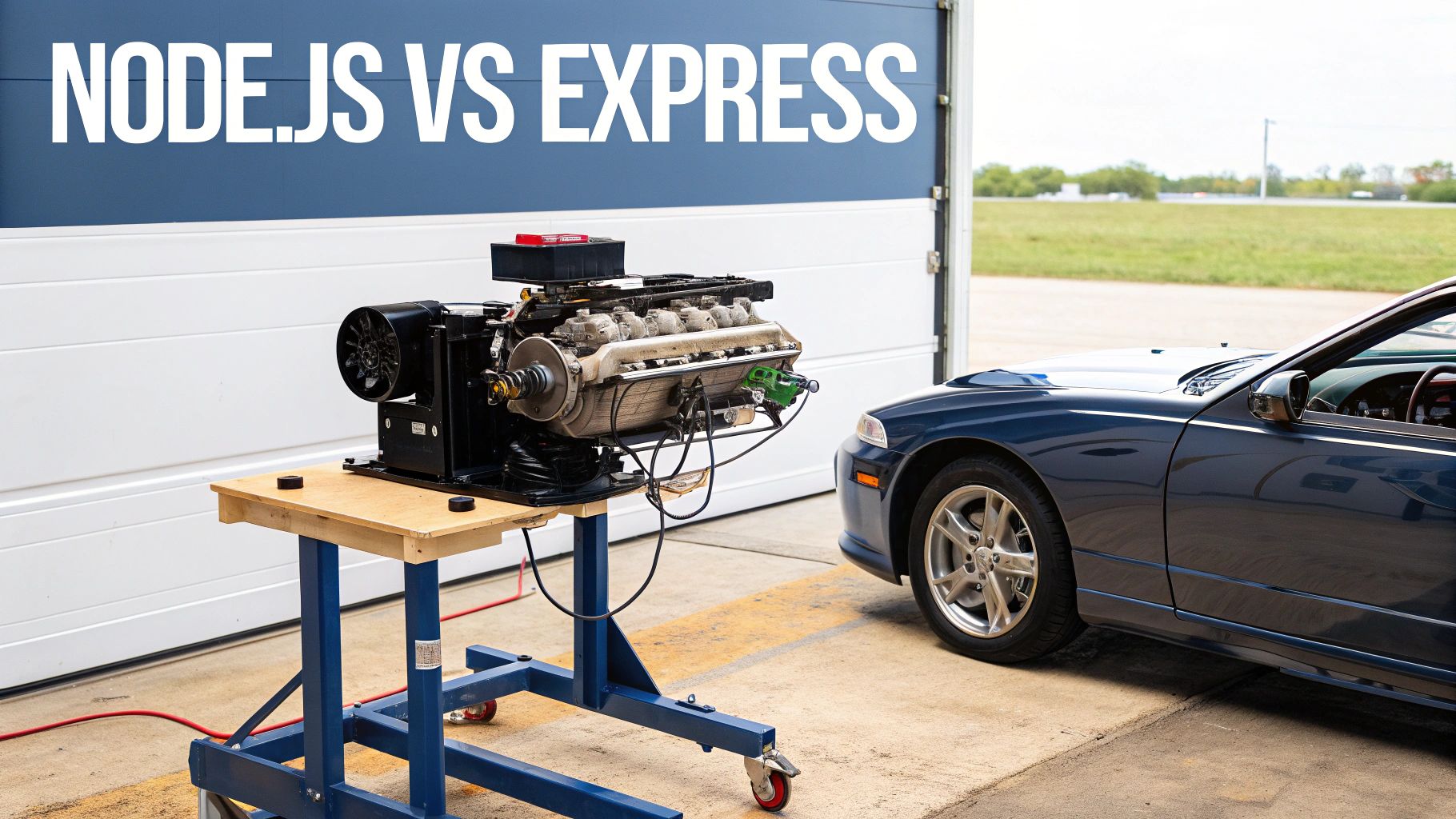
Many developers, especially those just getting into backend work, get hung up on comparing "Express JS vs Node JS." This is completely understandable, as they almost always appear together in tutorials and job descriptions. The key is realizing they aren't competitors; they're partners that solve different problems at different levels of abstraction. They form a synergistic pair that has become the backbone of modern web development for countless companies.
Think of it like this: Node.js is the raw, powerful engine. It's a JavaScript runtime that lets your code break free from the browser, giving you direct access to the file system, networking protocols, and other low-level OS features. You could build a web server using only Node.js, but you’d find yourself writing a ton of boilerplate code just to handle basic web traffic, parse incoming data, and manage different URL paths. This approach is powerful but can be slow and error-prone for complex applications.
That’s where Express.js steps in. Express is the vehicle built around that powerful engine. It provides the chassis, steering wheel, and dashboard—all the tools you need to harness the engine's power productively. It's a minimal and unopinionated web framework that offers a robust set of features for building everything from simple APIs to complex web applications. By handling the repetitive, low-level tasks, Express allows developers to focus on application logic and business features, drastically accelerating the development process.
Key Roles and Responsibilities
Node.js handles the foundational layer of server-side operations. Its event-driven, non-blocking I/O architecture is specifically designed for building scalable network applications. This makes it incredibly efficient at handling thousands of concurrent connections without getting bogged down, which is essential for real-time applications, APIs, and microservices.
Express, on the other hand, operates at a higher level, managing the application logic. It streamlines tasks that are tedious and complex to write in vanilla Node.js, providing elegant solutions for common web development challenges.
- Routing: It elegantly directs incoming HTTP requests (like
GET,POST,DELETE) to the correct handler function based on the URL path. This is far simpler than manually parsing request URLs. - Middleware: It lets you execute functions at different stages of the request-response cycle for things like authentication, logging, data parsing, or error handling. This modular approach is the cornerstone of Express's power and flexibility.
- Templating: It integrates with view engines like Pug, EJS, or Handlebars to render dynamic HTML pages on the server, making it suitable for building traditional, server-rendered web applications.
- Request/Response Helpers: It provides convenient methods on the request (
req) and response (res) objects, simplifying tasks like accessing query parameters, parsing request bodies, and sending JSON responses.
The real question isn’t about choosing one over the other. It’s about understanding how Express enhances Node.js, transforming it from a general-purpose runtime into a specialized and highly effective tool for web development.
This symbiotic relationship is why Express became the de facto standard framework for Node.js, with one report showing its adoption by a staggering 73% of Node.js developers. This widespread adoption means a vast ecosystem of plugins, tutorials, and community support, making it a safe and productive choice for projects of any scale.
Node JS vs Express JS At a Glance
To make this crystal clear, here’s a high-level summary that breaks down the fundamental roles and relationship between the runtime environment and the framework. This table should serve as a quick reference for anyone trying to explain the distinction to team members or stakeholders.
| Aspect | Node JS | Express JS |
|---|---|---|
| Primary Role | A JavaScript runtime environment that executes code on the server. | A web application framework that runs on top of Node.js. |
| Core Function | Provides core modules for networking (HTTP), file system access, and more. | Simplifies web development with features like routing, middleware, and request/response helpers. |
| Analogy | The powerful engine of a car. | The car's chassis, steering, and dashboard that make the engine usable. |
| Usage | Can be used standalone for scripts, CLI tools, or simple servers. | Requires Node.js to run; not a standalone technology. |
| Level of Abstraction | Low-level, giving developers fine-grained control over server operations. | High-level, abstracting away boilerplate code for faster development. |
| Example Use Case | Building a simple TCP server, a command-line utility, or a file processing script. | Building a RESTful API, a full-stack web application, or a microservice. |
Essentially, you use Node.js for its core capabilities—its speed, its non-blocking I/O, and its ability to run JavaScript on the server. You use Express.js to make building web applications with those capabilities faster, cleaner, and more organized.
Understanding Node.js as the Core Runtime Engine

Before we can really talk about "Express.js vs. Node.js," we have to get one thing straight: you can't have Express without Node.js. Think of Node.js as the engine and the chassis of a car—it’s the fundamental platform that makes everything else run. It’s a server-side runtime environment, which simply means it’s a program that lets you run JavaScript code on a server instead of just in a web browser. This single innovation unlocked the ability for millions of frontend developers to apply their JavaScript skills to backend development.
The secret sauce of Node.js is its event-driven, non-blocking I/O model. This sounds complicated, but the concept is pretty simple and is the key to its performance. Imagine a chef in a busy kitchen. A traditional, blocking I/O model is like a chef who takes an order, cooks the entire dish, serves it, and only then takes the next order. This is inefficient. Node.js is like a chef who takes an order, starts a pot boiling, and instead of just standing there watching it, immediately starts prepping the next dish. That’s Node.js. It kicks off a task (like a database query or a file read), then moves on to the next request without waiting. When the first task is done, an event is fired, and Node.js picks up the result.
This approach is incredibly efficient, allowing Node.js to handle thousands of connections at once without getting bogged down by slow I/O operations. It’s perfect for applications that have a lot of back-and-forth communication, like APIs, chat applications, and online gaming platforms.
The Powerhouse Duo: V8 and Libuv
So, how does it pull this off? Two key pieces of technology are working together under the hood: Google's V8 JavaScript engine and a C++ library called libuv.
- V8 Engine: This is the same high-performance engine that makes Google Chrome so fast. It takes your JavaScript code and compiles it into highly optimized machine code that computers can execute directly. V8 is what gives Node.js its raw speed for executing JavaScript logic.
- Libuv: This is the workhorse that handles all the asynchronous (non-blocking) operations. It manages the event loop, which is the heart of Node.js, and a thread pool to deal with things like network requests and file system access off the main thread. This ensures the main application thread never gets stuck waiting for a slow operation to complete.
Together, V8 and libuv make Node.js a beast at building real-time applications like chat platforms, streaming services, and API-driven microservices. The entire architecture is built for speed and scalability, especially for I/O-bound tasks, not for heavy, CPU-bound, number-crunching tasks like video encoding or complex scientific calculations.
The whole point of Node.js is to be lean and unopinionated. It gives you the raw power to build a server but doesn't tell you how to structure your application. That’s where frameworks come in.
Working with Vanilla Node.js
You absolutely can build a web server using just Node.js, right out of the box. This is often called "vanilla" Node.js. Using built-in modules like http, you can get a basic server up and running. The fs (File System) module lets you interact directly with files, and the net module allows for creating TCP servers.
This approach makes sense for simple, low-level tasks—maybe a tiny proxy server, a command-line tool where adding a whole framework would be overkill, or a specialized network service. But for anything more complex, you'll quickly find yourself writing a ton of boilerplate code just to handle basic routing, parse request data, and manage middleware. It gets messy, fast, and becomes difficult to maintain as the application grows.
This is why the Node Package Manager (NPM) is so critical. It’s the largest software registry in the world, giving you access to over a million open-source packages. This ecosystem allows frameworks like Express to exist, providing the structure and convenience needed for modern web development.
Today, Node.js is a major force, powering over 6.3 million web applications globally. Its relationship with frameworks is symbiotic, with a staggering 73% of Node.js developers using Express.js. For I/O-heavy applications, this combination can lead to 30-50% faster development timelines, making it a smart move for companies of all sizes. You can find more details on Node.js popularity and usage.
How Express.js Streamlines Application Development

While Node.js provides the raw engine for server-side JavaScript, building an application with it alone can feel like assembling a car from individual parts. You’d have to weld the frame, wire every component, and tune the engine yourself. This is where Express.js comes in, acting as the high-performance chassis that turns Node's power into a productive, streamlined vehicle for web development.
Express is a minimal and famously unopinionated web framework for Node.js. Its whole philosophy is to provide a thin layer of essential web features without hiding the powerful Node.js capabilities you're already familiar with. This gives you incredible freedom and avoids the rigid guardrails of more opinionated frameworks, allowing you to structure your application as you see fit while still benefiting from its powerful features.
The debate of Express.js vs. Node.js isn't really a competition; it's about augmentation. Express doesn't replace Node.js—it makes it better by stripping away a ton of boilerplate code, and the difference in development speed is immediately obvious. For any team looking to build and ship products quickly, this acceleration is a significant competitive advantage.
From Boilerplate to Brevity: A Code Comparison
To really see what Express brings to the table, let's compare building a simple web server. The goal: respond with "Hello, World!" on the root path / and return a 404 error for everything else. This is the "Hello World" of backend development.
First, here's how you'd tackle this with just the core http module in vanilla Node.js:
// Vanilla Node.js Server
const http = require('http');

const server = http.createServer((req, res) => {
  if (req.method === 'GET' && req.url === '/') {
    res.writeHead(200, { 'Content-Type': 'text/plain' });
    res.end('Hello, World!');
  } else {
    res.writeHead(404, { 'Content-Type': 'text/plain' });
    res.end('Not Found');
  }
});

server.listen(3000, () => {
  console.log('Server running on port 3000');
});
Now, let's build the exact same thing using Express:
// Express.js Server
const express = require('express');
const app = express();
const port = 3000;

app.get('/', (req, res) => {
  res.send('Hello, World!');
});

app.listen(port, () => {
  console.log(`Server running on port ${port}`);
});
The Express version is not only shorter but far more readable and declarative. It intelligently handles response headers (like setting Content-Type), manages the HTTP method (GET), and even provides default 404 logic for undefined routes, letting you focus on what your application actually needs to do. This clarity becomes invaluable as an application grows to dozens or hundreds of routes.
The Power of Middleware
The real magic behind Express is its concept of middleware. Think of middleware as a series of gatekeepers in an assembly line. Each middleware is simply a function that gets access to the request object (req), the response object (res), and a next function that passes control to the next checkpoint in the line.
These functions can execute code, modify the request or response objects, end the request-response cycle, or just pass the baton to the next middleware. This pipeline model is incredibly powerful and flexible.
Middleware is what transforms Node.js from a basic server into a highly organized and extensible platform. It’s the core mechanism that lets developers plug in functionality like authentication, logging, and error handling with clean, reusable code.
Common tasks handled by middleware include:
- Logging: Recording details about every incoming request (e.g., using
morgan). - Authentication: Verifying user credentials or JWT tokens before they can access a protected route (e.g., using
passport.js). - Body Parsing: Reading incoming request bodies (like JSON or URL-encoded data) and making them easily accessible on
req.body(e.g., usingexpress.json()). - CORS: Handling Cross-Origin Resource Sharing headers to allow requests from different domains.
- Error Handling: Creating a centralized safety net to catch errors thrown anywhere in the application and format responses consistently.
This modular approach keeps your main route handlers lean and focused on their specific business logic. For anyone new to backend development, learning to structure and test these routes and middleware is critical. To go deeper, check out our guide on effective RESTful API testing strategies.
By abstracting away these common concerns into middleware, Express lets developers build complex and secure applications much more efficiently than they ever could with Node.js alone. It promotes code reuse and separation of concerns, leading to more maintainable and scalable applications.
Architecture, Performance, and How They Scale Together
When you look past the basic definitions, the real difference between Node.js and Express.js comes down to structure and architectural guidance. Node.js gives you a powerful, single-threaded, event-driven engine. That’s the foundation. But without a framework, you're left to build every architectural pattern from the ground up, for every single project. This is where Express steps in to provide the scaffolding.
Think of it this way: Express gently nudges you toward established design patterns like Model-View-Controller (MVC) or variations like Model-View-Route-Controller. This approach keeps your application logic neatly separated into distinct parts (data logic, presentation, and request handling), making your code infinitely easier to manage, test, and debug as it grows. If you were to build with just plain Node.js, you'd be on your own to figure out how to organize files and logic, a path that often leads to a tangled, unmaintainable mess known as "spaghetti code."
Plus, Express was built from the ground up to create RESTful APIs. Its routing system is a huge leap forward from Node's built-in http module. Instead of complex conditional logic based on req.url, you get a clean, straightforward way to map HTTP methods (GET, POST, PUT, DELETE) and URLs (like /users/:id) to specific handler functions. This declarative style makes the API's structure obvious at a glance.
Performance and the Myth of Middleware Overhead
A fair question people often ask is, "Does Express slow down Node.js?" Technically, since Express is a layer on top of Node, it does add a tiny bit of overhead. But in the real world, this is almost always a non-issue. The productivity boost, improved code organization, and enhanced maintainability you gain are well worth the negligible performance cost.
The middleware architecture is at the heart of this conversation. Every piece of middleware adds a sliver of processing time to a request. Could you theoretically bog down your app with dozens of complex, poorly written middleware functions? Sure. But in practice, you’ll likely use a handful of highly optimized, essential ones for things like logging, authentication, or parsing request bodies.
The performance hit from Express is minimal. The framework's real strength is giving you control. You choose which middleware runs for each specific route or for the entire application, ensuring no unnecessary code gets executed. This is how you keep your application fast and lean while benefiting from the framework's structure.
How Scalability Works in the Node.js World
Scaling a Node.js application is all about working with its single-threaded nature, not against it. The event loop is a beast at handling I/O-heavy tasks (like database calls or talking to other APIs) without getting blocked. However, it can get hung up on CPU-intensive work (like complex calculations or image manipulation), as this would block the single main thread.
Thankfully, the ecosystem provides battle-tested tools to scale your application both vertically (on one machine with multiple CPU cores) and horizontally (across multiple machines).
- The Cluster Module: This module is built right into Node.js. It lets you create child processes, or "workers," that all share the same server port. This is how a single Node app can take full advantage of a multi-core processor, effectively multiplying its throughput by creating a worker for each core.
- Process Managers like PM2: Tools like PM2 (Process Manager 2) make managing these clusters a breeze. PM2 automatically creates worker processes based on the number of available CPU cores, restarts them if they crash (ensuring high availability), and even load-balances incoming traffic across them for you.
Express applications slot perfectly into this scaling model. You can cluster an Express server using these tools without changing a single line of your application code, which makes scaling a backend surprisingly straightforward. This also makes Express apps a natural fit for modern cloud deployments using containerization technologies like Docker and orchestration platforms like Kubernetes.
The industry has taken notice. The Node.js ecosystem, with Express as its most popular framework, is a powerhouse, driving over 50% of API-first applications worldwide. In fact, 73% of Node.js developers rely on Express to build everything from Backend-for-Frontend (BFF) architectures to microservices. This combination often leads to 20-35% infrastructure savings on I/O-heavy workloads compared to more resource-intensive stacks. Benchmarks have even shown Express hitting up to 44% higher Requests Per Second (RPS) than competing frameworks in specific tests. You can find more details on these Node.js usage and growth trends.
Technical Deep Dive: Node.js vs. Express.js Capabilities
To really see what Express brings to the table, let's break down how it enhances Node.js across key technical areas. The table below clarifies where the runtime's job ends and where the framework's structure begins.
| Capability | Vanilla Node.js (The Foundation) | With Express.js (The Structure) |
|---|---|---|
| Routing | You have to manually parse req.url with complex if/else or switch statements. This becomes unmanageable quickly. |
Offers a clean, declarative API for routing (app.get(), app.post()) with built-in support for dynamic parameters (/users/:id). |
| Request Handling | Requires you to manually parse request bodies and headers from raw data streams, which is complex and error-prone. | Middleware like express.json() automatically parses JSON bodies and populates the req.body object for you. |
| Response Handling | You must manually set status codes and content types using res.writeHead(). Sending JSON requires JSON.stringify() and setting headers. |
Provides simple helper methods like res.json(), res.send(), and res.status() to build responses concisely. |
| Error Handling | Needs explicit try/catch blocks inside every single request handler to manage errors properly, leading to repetitive code. |
A centralized error-handling middleware gives you a single, reliable place to catch and process all application errors consistently. |
| Scalability | Relies entirely on the core cluster module for leveraging multiple CPU cores. Configuration can be manual and complex. |
It’s fully compatible with the cluster module and integrates seamlessly with process managers like PM2 for easy, out-of-the-box scaling. |
As you can see, Express doesn't replace Node.js—it completes it for the purpose of web development. It takes the low-level, powerful capabilities of Node and provides the high-level abstractions needed to build robust, maintainable web applications efficiently.
Choosing the Right Stack for Your Project

Okay, let's cut through the technical jargon and get down to what matters: making the right decision for your project. The whole Express JS vs Node JS debate isn't about picking a "winner." It's about matching the right tool to the job you need to get done, considering factors like project complexity, team expertise, and time-to-market.
For almost any project that involves a web server, an API, or a user-facing application, your journey is going to start with Express.js. Think of it this way: Node.js gives you the engine and the chassis, but Express gives you the steering wheel, seats, and a dashboard. You could build those yourself, but why would you when a proven, reliable, and community-supported solution exists?
When to Go with Express JS
From my experience, Express is the go-to when you care about getting things done efficiently, keeping your code organized, and tapping into a massive community for support. It’s the default choice for a reason and is suitable for projects of all sizes.
You'll want to reach for Express for projects like these:
- RESTful APIs: This is Express's sweet spot. If you're building endpoints for a mobile app, a single-page application (SPA), or another service, Express makes defining routes for your CRUD operations (Create, Read, Update, Delete) clean and straightforward.
- Full-Stack Web Applications: By pairing Express with a templating engine like Pug or EJS, you can serve dynamic HTML pages directly. It’s a battle-tested setup for building traditional, server-rendered web apps, content management systems, and e-commerce sites.
- Microservices: Its lightweight footprint and fast startup time make Express a fantastic choice for building small, focused services within a larger microservice architecture. You can quickly spin up an API for a single business capability.
- MVPs and Startups: If you're trying to get a Minimum Viable Product (MVP) out the door, speed is everything. The massive ecosystem and simple learning curve of Express mean you can build, test, and iterate incredibly fast, allowing you to validate your ideas with real users sooner.
When to Use Vanilla Node JS
Now, choosing to work with just Node.js—what we often call "vanilla Node"—is a very specific and deliberate decision. You’re trading the convenience of a framework for raw, unadulterated control and minimal performance overhead. It’s less common for building full applications, but for certain specialized tasks, it’s absolutely the right call.
You might go with vanilla Node.js for things like:
- High-Performance Network Services: If you're building a simple TCP server, a custom proxy, a load balancer, or another specialized network tool where every millisecond counts, ditching the framework overhead can give you a crucial performance edge.
- Streaming Applications: Node’s built-in
streammodule is exceptionally good at handling large, continuous streams of data. For applications involving real-time video processing, large file uploads, or data pipelines where memory efficiency is key, working directly with streams in Node can be more effective. - Command-Line (CLI) Tools: For creating a utility that runs in the terminal (like a code linter or a deployment script), you often just need Node's core modules like
fs(file system) andchild_process. Bringing in a web framework would be unnecessary bloat.
A Look at the Broader Ecosystem
While Express is the undisputed king in terms of popularity and community size, it’s not the only game in town. The Node.js ecosystem is full of great alternatives, and knowing about them gives you more options to tailor your stack to your specific needs.
- Koa.js: Built by the original Express team, Koa leverages modern JavaScript features like
async/awaitto create a more elegant and robust middleware flow. It's a great way to avoid the "callback hell" that can sometimes trip people up in complex Express apps. - Fastify: The name says it all. Fastify is obsessed with speed, prioritizing low overhead and high-performance routing through a schema-based approach. If raw throughput is your number one metric for an API, you should definitely give it a look.
- NestJS: For teams that prefer a more structured, opinionated approach, NestJS is a powerful choice. Built with TypeScript, it provides a highly organized, modular architecture inspired by Angular, making it excellent for large-scale enterprise applications.
Understanding where these tools fit in provides a ton of context. If you want to dive deeper, we have a complete guide on how to choose the right tech stack for your project.
Decision Checklist
- Building a web application or API? Start with Express. It's the pragmatic, productive, and well-supported choice.
- Need to ship a product fast? Express. The development speed and massive ecosystem are unmatched.
- Creating a low-level network tool or a simple script? Vanilla Node.js is all you need. No framework required.
- Is raw performance your absolute top priority for an API? Look at vanilla Node.js or a performance-first framework like Fastify.
- Does your team love modern
async/awaitsyntax and a cleaner middleware flow? Koa.js will feel right at home.- Building a large, complex enterprise application with TypeScript? NestJS provides the structure you'll need.
Deploying Your Node and Express App with Vibe Connect
Choosing between vanilla Node.js and Express is a crucial architectural decision, but it's only the first step. The journey from a working codebase on your local machine to a secure, scalable, and reliable product in the cloud is where most teams hit a wall. This is where the focus shifts from writing code to achieving operational excellence, and hurdles like complex deployments, security hardening, performance monitoring, and infrastructure management can bring progress to a grinding halt.
This operational gap is exactly what Vibe Connect is designed to solve. We're an AI-powered automation partner that ensures your Node.js and Express application doesn't just run—it thrives in a production environment, meeting the highest standards of performance, security, and scalability.
From Codebase To Cloud With Confidence
It all starts with our specialized AI agents. They analyze your application's codebase to understand the specific nuances of your Node.js and Express architecture. This deep analysis generates clear development guidelines, identifies potential performance bottlenecks, and flags security vulnerabilities long before they can cause problems in production.
From there, we connect your project with a handpicked expert from our network of "Vibe Shippers"—seasoned professionals who live and breathe your exact tech stack. They work alongside your team to implement best practices and set up a rock-solid operational foundation.
Vibe Connect takes the operational guesswork out of the equation. We manage the heavy lifting of deployment, scaling, and security, so you can focus entirely on your product's vision and your users.
Our approach is built to get your application to market faster while embedding industry best practices from the very beginning. Here’s how we do it:
- Architecture Alignment: We make sure your application's design is truly optimized for scalability and resilience in the cloud, helping you avoid common pitfalls that can hinder growth.
- DevOps Implementation: We set up automated CI/CD (Continuous Integration/Continuous Deployment) pipelines to make your staging and production rollouts smooth, fast, and repeatable.
- Built-In Observability: Performance monitoring, logging, and alerting are integrated from the start, giving you deep visibility into your application's health and allowing you to proactively address issues.
- Rigorous Security: We implement threat modeling, least-privilege access controls, and autoscaling infrastructure to protect your product from day one against common vulnerabilities and traffic spikes.
If you want to get into the weeds of modern deployment techniques, check out our detailed guide on how to configure a Docker Compose entrypoint. With Vibe Connect, your application gets production-ready, connecting your vision with flawless execution.
Frequently Asked Questions
Even with a solid grasp of the relationship between Node.js and Express.js, some common questions tend to surface. Let's tackle them head-on to clear up any final confusion.
Can You Use Node JS Without Express JS
You absolutely can. Node.js is a powerful, standalone runtime. You can build a perfectly capable web server using only its native http module without ever touching a framework. This is a fundamental concept to grasp: Node.js is the foundation, and frameworks are optional additions.
This bare-bones approach is great for small, specialized tasks where you need maximum performance and minimal overhead—think simple proxy servers, a quick CLI tool for automating a task, or a specialized data streaming service. But for a full-fledged web application, you'd find yourself manually writing a ton of code for routing, handling requests, and sending responses. That's exactly the kind of repetitive, error-prone work frameworks like Express were designed to eliminate.
Is Express JS the Only Framework for Node JS
Not at all. While Express has long been the go-to choice and boasts a massive, mature ecosystem, the Node.js world is full of fantastic alternatives, each with a different philosophy and set of trade-offs for building web applications.
- Koa.js: From the original team behind Express, Koa offers a more modern design using
async/awaitto make middleware cleaner and more intuitive, helping developers avoid "callback hell." - Fastify: True to its name, Fastify is all about performance. Its focus on speed and low overhead, achieved through techniques like schema-based JSON serialization, makes it a strong contender for high-traffic APIs and microservices.
- NestJS: If you're looking for structure and a more "batteries-included" experience, NestJS delivers. It’s a highly opinionated framework built on TypeScript that provides a robust, modular architecture reminiscent of enterprise frameworks like Angular or Spring.
The right framework really comes down to your project's specific needs and your team's preferences. Do you prioritize structure, raw performance, or developer experience? For many, Express remains the default choice due to its simplicity, flexibility, and unparalleled community support.
Which Is Faster Node JS or Express JS
This question highlights a common mix-up in understanding the relationship. It's not really a fair fight, because Express runs on top of Node.js. Think of Node.js as the engine and Express as the car's control system—one can't run without the other in this context. The proper comparison would be "vanilla Node.js vs. Express.js."
Technically, since Express adds a layer of abstraction for convenience (like routing and middleware), it introduces a tiny bit of performance overhead. A pure, hyper-optimized vanilla Node.js server will always be a fraction of a second faster for a simple request. But in almost every real-world scenario, this difference is completely unnoticeable and outweighed by other factors like database query times or external API calls. The productivity boost, cleaner code, and easier maintenance you get from Express are well worth the negligible performance trade-off.
Ready to take your Node.js and Express application from your local machine to a live environment without the usual operational headaches? Vibe Connect combines AI-powered analysis with expert "Vibe Shippers" to manage your deployment, scaling, and security. This leaves you free to focus on what you do best: building an amazing product. Discover how we can connect your vision with flawless execution at https://vibeconnect.dev.