

Ever wonder why so many brilliant AI projects die on the vine, never making it out of the research lab? The bridge between a clever model and a real-world product is a practice called DevOps for Machine Learning, or MLOps. It’s the essential framework that stops promising AI from gathering dust and starts it delivering real value. This comprehensive guide will walk you through the why, what, and how of implementing MLOps to ensure your machine learning innovations successfully transition from lab to live production.
From Brilliant Models to Production Realities
It’s a story I’ve seen play out time and time again. A data science team builds a fantastic machine learning model, one with the potential to genuinely move the needle for the business. But it gets stuck. It never reaches production, where it can actually do its job and generate impact. The gap between a functional prototype and a reliable, scalable production system is vast, and many teams underestimate the engineering discipline required to cross it.
Think of it like a world-class chef who dreams up an incredible, Michelin-star-worthy recipe but can't get the dish to the table because the kitchen is a disorganized mess. The ingredients are there, the talent is undeniable, but without a systematic process for preparation, cooking, and plating, the final product never reaches the customer.
This is exactly the problem DevOps for Machine Learning solves. MLOps isn’t just some trendy term; it's the disciplined 'kitchen management' that turns experimental models into stable, scalable, and reliable applications. It achieves this by blending the best practices from Machine Learning, classic DevOps, and Data Engineering to automate and streamline the entire AI lifecycle, from data ingestion to model monitoring and retraining.
Why MLOps Is a Game Changer
Without a structured MLOps process, teams are trapped in a painful, inefficient loop. Deployments are manual, fragile, and error-prone. Development and production environments are inconsistent, leading to the dreaded "it worked on my machine" syndrome. Once a model is finally live, nobody has a clear, automated way to track if it's even working correctly or if its performance is degrading over time. This chaos is a huge reason so many AI initiatives fail to leave the nest and deliver on their initial promise.
A solid MLOps foundation changes everything. It provides the guardrails, automation, and collaborative frameworks needed to move fast without breaking things. The core goals are straightforward and transformative:
- Automation: Get humans out of the loop wherever possible—from data pipelines and model training all the way to deployment, monitoring, and even automated retraining. This reduces manual error and frees up your talented team for more valuable work.
- Reproducibility: Anyone on the team should be able to reproduce an experiment or a production result, every single time. This involves versioning not just code, but also data and models. Consistency is key for debugging, auditing, and building trust in the system.
- Collaboration: Tear down the organizational silos that traditionally separate data scientists, ML engineers, and the operations folks. MLOps fosters a shared ownership model where everyone works together within a unified workflow.
- Reliability: Build systems that are robust, scalable, and easy to maintain without constant firefighting. This means thinking about security, performance, and cost-efficiency from day one.
The industry is waking up to this reality in a big way. In 2023, the AI in DevOps market was valued at around USD 2.9 billion. That figure is projected to skyrocket to USD 24.9 billion by 2033, a testament to how critical MLOps has become for solving the operational bottlenecks that kill AI projects. HexaView has some great research on this market explosion.
MLOps is about treating machine learning models as first-class software artifacts. It applies the same rigor, automation, and lifecycle management to models that we've applied to code for years, while also accounting for the unique challenges posed by data.
This guide will give you a clear roadmap for turning your AI concepts into tangible business outcomes. By adopting these principles, you can deploy, monitor, and scale your applications with confidence, ensuring your innovations actually make an impact. For a deeper look at the practical steps involved, check out our guide on creating a production readiness checklist.
Why Traditional DevOps Is Not Enough for AI
Trying to apply standard DevOps practices to a machine learning project is a bit like using a city blueprint to manage a sprawling, ever-changing garden. The blueprint is static, engineered from a fixed plan with predictable components. But the garden is a living, dynamic system that constantly evolves with new data (sunlight, water, soil conditions), demanding continuous care, adaptation, and occasional replanting.
This is precisely why we need DevOps for machine learning, or MLOps, as its own distinct discipline. Traditional DevOps is fantastic for managing application code, which is deterministic—the same input will always produce the same output. ML systems, however, are built on two equally important and volatile pillars: code and data. A subtle shift in either one can completely change the system's behavior, often in unpredictable ways. The complexity multiplies because a third artifact, the trained model, is a product of both.
The Experimental Nature of Machine Learning
Software development usually follows a relatively linear path of building, testing, and shipping features. Machine learning, on the other hand, is anything but. It's a deeply experimental, scientific process that runs in iterative cycles: prepare data, engineer features, train a model, and evaluate its performance. A significant number of these cycles end in dead ends or incremental improvements, making the entire process inherently uncertain.
This iterative, trial-and-error nature creates complexities that traditional CI/CD pipelines just weren't designed for. A model that performs beautifully in the lab today might see its accuracy plummet tomorrow in the real world. This isn't necessarily because of a bug in the code, but because the live data it’s seeing has changed. We call this phenomenon concept drift, and it's a core challenge MLOps is built to address.
Think about a model trained to predict housing prices. If a new highway gets built, a major local employer shuts down, or interest rates change, the underlying patterns in the housing market shift. The model, trained on historical data, will quickly become unreliable unless there's a system in place to detect this drift, trigger retraining on new data, and safely redeploy an updated version.
To give you a clearer picture, let's break down the core differences head-to-head.
Traditional DevOps vs MLOps A Core Comparison
The table below really highlights how the focus shifts when you move from managing traditional software to managing intelligent, data-driven systems.
| Aspect | Traditional DevOps | DevOps for Machine Learning (MLOps) |
|---|---|---|
| Primary Artifacts | Application Code, Binaries | Code, Data, Models |
| Core Trigger | Code Commit | Code Commit, New Data, Model Degradation |
| Versioning Focus | Code (e.g., Git) | Code, Datasets, and Model Versions |
| Testing Approach | Unit, Integration, E2E Tests | Includes Data Validation, Model Quality Tests, and A/B testing |
| CI/CD Pipeline | Build -> Test -> Deploy Application | Train -> Validate -> Deploy Model -> Monitor |
| Monitoring | System health (CPU, RAM), App errors | Model Performance (accuracy, drift), Data Drift, Prediction Bias |
| Team Skills | Software Engineers, Ops Engineers | Adds Data Scientists, ML Engineers, Data Engineers |
| Development Cycle | Linear and feature-driven | Highly iterative and experimental |
As you can see, MLOps doesn't just add a few new steps; it redefines the entire lifecycle around the data and models that power the application, introducing new roles, new artifacts, and new automation triggers.
Going Beyond Code Versioning
In the world of traditional DevOps, a version control system like Git is the undisputed source of truth for the application's state. With MLOps, that's only part of the story. To ensure your work is truly reproducible, you absolutely must version your datasets and models with the same rigor you apply to your code.
Without that, you can't trace a model's strange behavior back to the exact data and hyperparameters that created it. This makes debugging a nightmare, prevents you from rolling back to a previous known-good state, and turns compliance audits into an impossible task.
- Data Versioning: Tracking changes to your datasets is every bit as critical as tracking code changes. This ensures every experiment and every production model can be perfectly recreated, which is essential for scientific integrity and regulatory compliance.
- Model Versioning: Each trained model is an artifact that needs its own version and a rich set of metadata. This includes its performance metrics on a holdout set, the training parameters used, and a clear, unbreakable link back to the specific data and code versions it was trained on.
This multi-layered versioning is a cornerstone of MLOps and a huge departure from code-only pipelines. For startups, grasping these operational differences early on can save them from accumulating massive technical debt that will stifle future innovation. You can learn more about how these principles apply in our guide to DevOps for startups.
Unique Pipeline and Monitoring Needs
Finally, the deployment and monitoring requirements couldn't be more different. A traditional DevOps pipeline pushes a new version of an application. An MLOps pipeline, in contrast, might automatically trigger a full retraining process based on an alert that model performance is degrading in production. The pipeline itself becomes a dynamic, responsive system.
Monitoring is no longer just about CPU usage or HTTP 500 errors. You're now tracking complex statistical metrics like model accuracy, shifts in data distribution (data drift), and prediction latency. These specialized metrics are vital for maintaining the health and trustworthiness of a live AI system, making sure it keeps delivering business value long after it’s first deployed.
Building Your Automated MLOps Pipeline
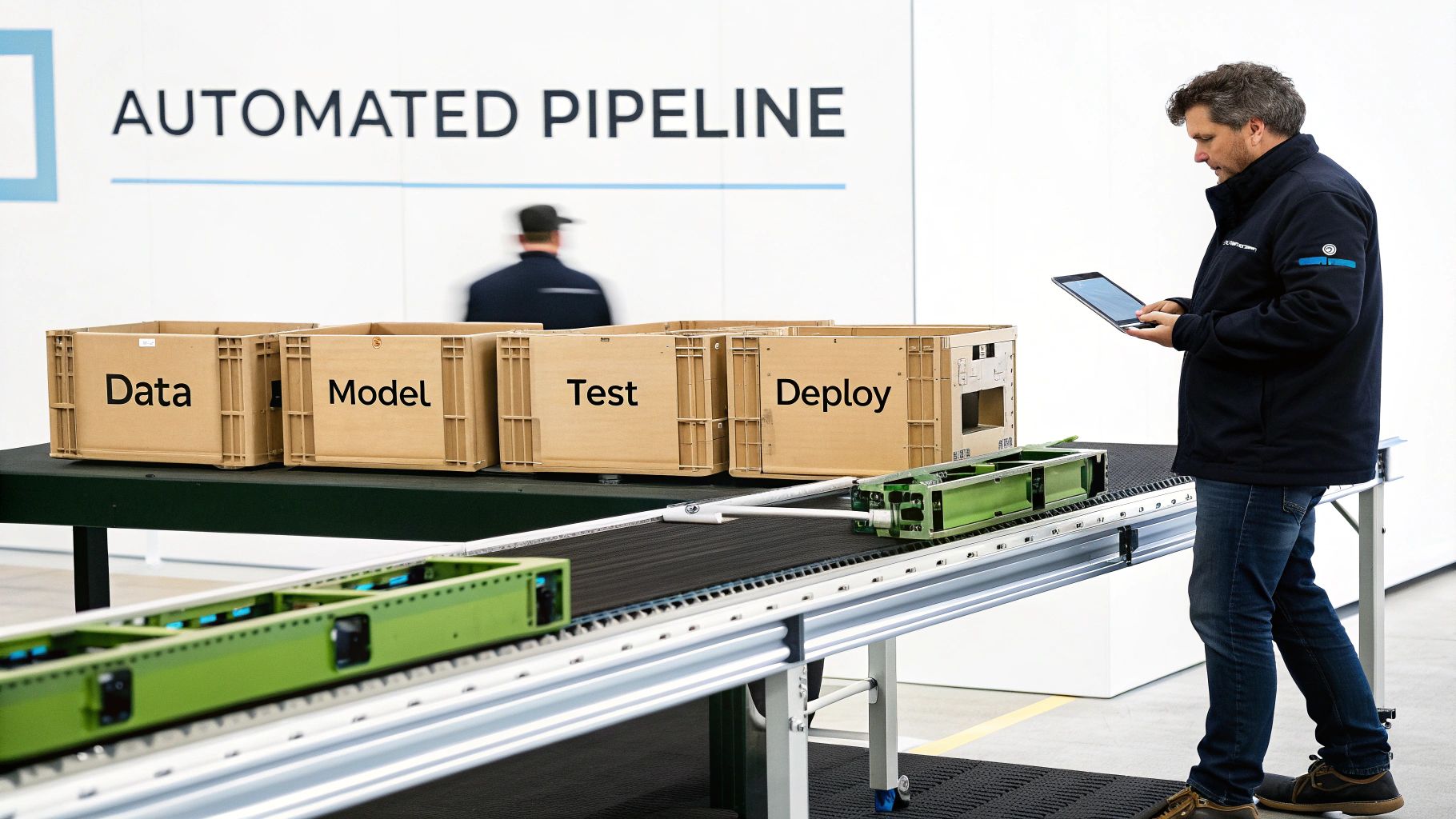
Think of a modern MLOps pipeline as an automated, intelligent assembly line for your AI models. It’s the engine that takes a promising experiment from a data scientist’s notebook and turns it into a reliable, battle-tested asset in production. When you break it down, this pipeline is a series of connected, automated stages, all designed to bring consistency, quality, and speed to the entire machine learning lifecycle.
Data and Model Versioning: The Bedrock of Reproducibility
Before a single line of automation code runs, you have to get the foundation right. In MLOps, that foundation is versioning—and I'm not just talking about code. You need to version your data and your models, too. Think of it as a detailed, immutable lab notebook for every single experiment, automatically logging every variable so you can perfectly recreate any result, anytime.
Without it, you’re flying blind. If a model suddenly starts making bizarre predictions, you have no way to trace it back to the exact dataset or hyperparameters that created it. This isn't just an inconvenience; it's a critical failure of governance and quality control.
- Data Versioning: This is all about taking immutable snapshots of your datasets. Tools like DVC (Data Version Control) are built for this; they work alongside Git to track huge data files without clogging up your code repository. This ensures every model training run is tied to a specific, unchangeable version of the data, guaranteeing reproducibility.
- Model Versioning: Every trained model is an artifact with its own story. A proper model registry doesn't just store the binary model file. It logs its performance metrics, the parameters used to train it, and a clear link back to the exact versions of the code and data that produced it. This metadata is as important as the model itself.
Getting this dual versioning approach right is the first—and most critical—step in moving from chaotic experimentation to disciplined, auditable engineering.
CI/CD for Models: Automating the Core Workflow
With versioning in place, you can finally automate the heart of the MLOps process: a CI/CD (Continuous Integration/Continuous Delivery) pipeline built specifically for machine learning. While it shares a name with its cousin in traditional DevOps, its job is fundamentally different and more complex.
This isn't just about compiling code and running unit tests. An MLOps CI/CD pipeline automates the entire sequence of model training, validation, and packaging. A trigger—like a new code commit, a fresh version of the dataset, or even a signal from your monitoring system—kicks off the entire assembly line automatically.
The process usually breaks down into a few automated stages:
- Continuous Integration (CI): The pipeline starts with the usual suspects: code tests and linting. But it also runs critical data validation checks to ensure data quality and schema consistency, and tests the model training code itself to ensure it works as expected.
- Continuous Training (CT): If the CI stage passes, the pipeline automatically spins up a new training job. This step retrains the model on the latest version of the data using the versioned code, ensuring everything is reproducible and up-to-date.
- Continuous Delivery (CD): After training, the new model goes through rigorous validation against a predefined test set. If it meets your performance thresholds (for example, accuracy above 95% and lower latency than the current production model), it gets packaged, versioned, and pushed to the model registry, ready for deployment.
This is a continuous, self-improving loop where every component feeds back into the system, ensuring it gets smarter and more reliable over time.
Intelligent Deployment Patterns
Getting a validated model into the registry is a huge win, but you're not done yet. Deploying it to production needs a careful, risk-averse strategy to avoid negatively impacting the user experience. Instead of a risky "big bang" release where you switch everything at once, MLOps relies on smarter, more controlled deployment patterns.
- Canary Deployment: You route a small fraction of live traffic—say, 5% of users—to the new model version. The vast majority of users stay on the old, stable one. This lets you watch the new model's performance and stability in a controlled, real-world setting before you commit to a full rollout.
- Shadow Deployment: Here, the new model runs in parallel with the old one in the production environment. It gets the same live data, but its predictions are never shown to users; they are simply logged. It’s a powerful, completely risk-free way to compare its performance against the model currently in production on live data.
- A/B Testing: You can deploy multiple model versions at the same time and route different user segments to each one. This allows you to directly measure which model performs better on key business metrics (like conversion rate or user engagement), not just technical ones like accuracy.
Observability: Monitoring What Matters
Once a model is live, the pipeline’s job shifts from building to observability and monitoring. And this goes way beyond just tracking server CPU and memory. MLOps monitoring has to focus on the unique ways AI systems can degrade and fail silently.
You need to be tracking key indicators like:
- Data Drift: Is the new, incoming data starting to look fundamentally different from the data the model was trained on? This is a leading indicator of future performance degradation.
- Concept Drift: Have the underlying patterns in the data changed? For example, has user behavior shifted due to external factors, causing the model's predictions to become less accurate?
- Performance Metrics: How is the model's accuracy, precision, or recall holding up on live data streams? Are there specific segments of data where performance is much worse?
A solid monitoring system will alert you to these issues, and in a truly mature setup, these alerts can automatically trigger the CI/CD pipeline to retrain and redeploy a new, sharper model. That’s how you close the automation loop and build a self-healing AI system.
This whole framework of DevOps for machine learning isn't just theory—it drives real, measurable business results. An incredible 99% of organizations report positive impacts from adopting DevOps, and 49% manage to cut their time-to-market, which is crucial for getting AI features into users' hands faster and staying ahead of the competition. You can dig into more of these trends in Dataintelo's research.
Securing and Scaling Your AI Systems
Getting a machine learning model into production is a lot like launching a ship. You've spent months, maybe years, designing and building it. Now comes the hard part: making sure it can handle the open sea—the unpredictable storms of security threats and sudden tidal waves of user traffic. This is where so many promising AI projects run into trouble, failing not because the model was bad, but because the surrounding infrastructure was not robust enough.
To succeed, you have to think beyond just the model's code. Securing an AI system isn't just about locking down an API endpoint; it’s about protecting the entire supply chain, from the data pipelines that feed the model to the final deployed artifact. Similarly, scaling isn’t just about throwing more servers at the problem. It’s about building a smart, elastic infrastructure that can expand and contract on demand without burning a hole in your budget.
A Modern Approach to ML Security
In the world of DevOps for machine learning, security isn't a final checklist item that you think about before launch—it's woven into every single step of the lifecycle. This approach, often called DevSecOps, is all about applying a security-first mindset from day one. The goal is to catch and fix vulnerabilities early and automatically, long before they ever see the light of day in production where they can be exploited.
This means you’re constantly asking tough questions at each stage of your MLOps pipeline:
- Data Integrity: Can we trust our training data? A savvy attacker could perform a "data poisoning" attack by subtly tweaking the training data to make the model misbehave in critical situations or create a backdoor.
- Model Tampering: Once the model is live, could someone intercept it or change its internal weights? That deployed model file is a valuable intellectual property and a potential attack vector. You must protect it both in transit and at rest.
- Data Privacy: Are we handling user data correctly and ethically? With regulations like GDPR and CCPA, a single misstep in data handling can lead to massive fines and an irreversible loss of user trust.
- Access Control: Who gets the keys to the kingdom? You need strict, role-based access control (RBAC) rules for who can retrain models, approve new deployments, or touch sensitive production data. The principle of least privilege is your best friend here.
DevSecOps for ML isn't about buying a single security tool; it's a cultural shift. Security becomes a shared responsibility across data science, engineering, and ops, with automated security checks, vulnerability scanning, and compliance validation built right into your CI/CD pipelines.
Building for Unpredictable Growth
Scalability is the other giant in the room, especially when you’re launching a new AI product. User traffic is notoriously fickle. One viral blog post, a successful marketing campaign, or a mention on social media can crank your request volume from a lazy trickle to a raging flood in minutes. If your infrastructure can't keep up, your app crashes, users have a terrible experience, and that golden opportunity for growth is gone.
This is why autoscaling is absolutely non-negotiable for modern AI applications. Autoscaling allows your system to automatically add or remove computing power—servers, containers, or pods—based on real-time metrics like CPU utilization or request queues. It ensures you have just enough muscle to handle the current load, giving users a seamless, fast experience without you having to pay for a stadium's worth of idle servers during quiet times.
The industry has taken notice of these operational necessities. The DevSecOps market, a cornerstone of secure MLOps, was valued at USD 3.73 billion in 2021 and is projected to explode to USD 41.66 billion by 2030. That kind of growth tells you everything you need to know about how vital these practices are for building AI that actually works reliably and securely in the real world. You can discover more insights about DevOps statistics from Spacelift to see just how big this trend has become.
Performance Tuning and Cost Optimization
Finally, a system that’s both secure and scalable still needs to be affordable. The powerful GPUs and CPUs needed for model inference can get seriously expensive, especially when you're operating at scale. This is where continuous performance tuning and cost optimization enter the picture as a critical MLOps practice.
The whole point is to optimize both your model and your infrastructure to do more with less computational cost. Common techniques include:
- Model Quantization and Pruning: These techniques involve reducing the precision of the numbers inside your model (quantization) or removing unnecessary connections (pruning). This makes the model smaller and faster, often with very little hit to its accuracy, reducing inference costs.
- Hardware Selection: It's about picking the right tool for the job. Sometimes, a cheaper CPU is actually more cost-efficient for a specific task than a pricey GPU, especially for batch processing or simpler models.
- Resource Monitoring and Right-Sizing: You can't fix what you can't see. Using tools to constantly watch your resource usage helps you spot bottlenecks, eliminate waste, and ensure your autoscaling policies are set correctly. If you want to go deeper, check out our guide on essential machine learning model monitoring tools.
When you tie security, scalability, and cost optimization together into your automated MLOps framework, you create a system that isn't just powerful. It's resilient, efficient, and truly ready to grow with your audience.
Your Practical Roadmap to Implementing MLOps
Jumping into DevOps for machine learning isn't a single, massive leap that happens overnight. Think of it more like leveling up in a game—you start with the basics, master them, and gradually build more advanced skills and capabilities over time. This roadmap is built for startups and growing teams, focusing on maturing your process step-by-step without splurging on complex, enterprise-grade tools you just don't need yet.
The whole idea is to figure out where you are right now and what the next sensible step is. When you break the journey into these manageable stages, adopting MLOps starts to feel achievable instead of impossibly huge.
Stage 1: The Manual and Ad-Hoc Phase (Level 0)
This is where almost everyone starts. It’s the "Wild West" of machine learning, a world held together by manual processes, individual scripts, and the heroic efforts of a few key people.
- Model Development: Data scientists are off in their own worlds, typically working in isolated Jupyter notebooks on their laptops. Code is not versioned, and environments are not standardized.
- Deployment: A finished model gets "tossed over the wall" to an engineer who deploys it by hand, usually with some custom scripts or by simply copying files into place. The process is manual, slow, and error-prone.
- Monitoring: If there’s any monitoring at all, it's completely reactive. You only find out something is broken when a customer complains or a downstream system fails.
This approach might get a one-off proof of concept out the door, but it’s fragile, non-reproducible, and impossible to scale. Nothing is repeatable, and all the critical knowledge is stuck in one person's head.
Stage 2: Foundational Automation (Level 1)
Here's where you take your first real step toward a sane, repeatable process. The goal is simple: get everything under version control and build a basic, automated pipeline for training. You're essentially building the good habits that everything else will depend on later.
This stage is all about getting past "it works on my machine." You're finally introducing the discipline of software engineering into the often chaotic, experimental world of data science and creating a single source of truth.
Here’s your checklist for getting through this phase:
- Code Versioning: All code—notebooks, scripts, configuration files, everything—lives in a Git repository. No exceptions.
- Data and Model Versioning: Start using a tool like DVC to track your datasets and large model files. Set up a simple model registry (even a shared storage bucket with a clear naming convention is a start) to store and version your trained models.
- Basic Training Pipeline: Write a single, automated script that can reliably train your model from start to finish, from data preprocessing to saving the final model artifact. This script is now the one source of truth for your training process.
Once you’ve nailed this stage, you can finally reproduce any model and trace its entire history, from the exact code that built it to the specific data it was trained on. This is a massive leap forward.
Stage 3: Full CI/CD Automation (Level 2)
Okay, now you’re ready to connect the dots and automate the workflow. It’s time to build a real CI/CD pipeline for your models, bridging the gap between the data science team and operations. The mission here is to make retraining and deploying a new model a boring, routine, low-risk event, rather than a high-stress, all-hands-on-deck affair.
At this level, your workflow should look something like this:
- Trigger: Someone pushes a change to your Git repo (new code, or maybe a new version of the data registered with DVC).
- CI/CT: This push automatically kicks off a pipeline that validates the data, runs your tests, and retrains the model in a clean, consistent environment.
- Validation: The freshly trained model is automatically tested against a holdout dataset to see if its performance meets predefined thresholds (e.g., accuracy > 90%).
- CD: If the new model passes validation, it's automatically packaged, versioned, saved to the model registry, and deployed to a staging environment for further testing.
This kind of automation slashes manual errors, dramatically speeds up the iteration cycle, and frees up your team to work on what really matters—building better models—instead of constantly putting out deployment fires. It’s a huge milestone in your DevOps for machine learning strategy.
Stage 4: Advanced MLOps (Level 3)
The final stage is all about sophistication, optimization, and closing the feedback loop. Your pipeline is solid, but now it’s time to make it smarter, faster, and more resilient. This is where you bring in advanced deployment patterns, deep monitoring with automated triggers, and serious governance.
Key capabilities you're building here include:
- Automated Retraining: Your monitoring system detects data drift or a dip in model performance and automatically triggers the CI/CD pipeline to retrain, validate, and deploy a fresh model without human intervention.
- A/B Testing and Canary Deployments: You have a robust system for safely rolling out new models to a small slice of users, letting you compare their performance against the old model in the real world before a full launch.
- Full Observability: You’ve got comprehensive dashboards tracking everything in real-time—model accuracy, data distributions, prediction latency, and the business KPIs the model is supposed to be driving.
- Governance and Compliance: Every action in your system—from a training run to a deployment approval—is logged, giving you a complete audit trail for any regulatory or compliance requirements.
By working your way through these stages, you build a mature and scalable MLOps practice that transforms machine learning from a risky, artisanal experiment into a reliable, repeatable engine for business growth.
How Vibe Connect Turns Your AI Vision into Reality
We've walked through the entire, often grueling, journey of DevOps for machine learning. It’s a road paved with complex pipelines, tricky security risks, and massive scaling hurdles. Let's be honest—for teams whose real passion is innovating on the product itself, building out a robust MLOps foundation is a huge, time-sucking distraction from what they do best. It requires a specialized skill set that is distinct from data science and application development.

This is exactly where Vibe Connect comes in. Think of us as a natural extension of your team, the specialists who handle the nitty-gritty of production so you can keep your eyes on the prize: your product vision and your users. Our model is pretty unique—we blend smart, AI-powered code analysis with a team of seasoned delivery experts we call "Vibe Shippers," people who’ve successfully launched and scaled tech stacks just like yours before.
Get From Vision to Value, Faster
Instead of getting bogged down for months trying to configure infrastructure, build CI/CD pipelines, and troubleshoot operational fires, you can tap into our experience right from the start. We go straight after the core operational problems that sink promising AI projects, letting you move from a great idea to a live product with genuine speed and confidence.
The whole point is to make sure your brilliant AI ideas actually make it into the real world, not wither away in development hell. We take on the operational chaos so you can stay focused on building something your users will love and solving the core business problem.
With Vibe Connect, the payoff is immediate and clear:
- Faster Time-to-Market: We get you launched quicker. By implementing field-tested, production-grade MLOps practices from the get-go, we dramatically shorten the timeline to get your product into users' hands and start generating value.
- Reduced Operational Risk: Our team owns deployment, scaling, monitoring, and security. That means you sidestep the costly production failures, security vulnerabilities, and late-night emergencies that can kill a project and burn out your team.
- Scalable by Design: We don't just build for today's prototype. We construct your system on a secure, autoscaling foundation that’s engineered to grow right alongside your user base, ensuring reliability and cost-efficiency as you succeed.
Your Dedicated Partner for Production
The best way to see us is as your dedicated production team. While you're busy experimenting with new model architectures and tweaking the UI, we're in the background making sure the entire system is solid, secure, and ready for whatever comes its way. This kind of partnership lets you completely bypass common blockers like tangled deployments, infrastructure bottlenecks, and security blind spots.
When you hand off the operational side of MLOps to Vibe Connect, you're doing more than just offloading tasks—you're securing a real strategic advantage. It gives your team the freedom to innovate without fear, knowing the path to production is clear, safe, and handled by people who've done it a hundred times before.
MLOps FAQ: Your Questions Answered
Diving into MLOps often brings up a handful of common questions. We've tackled some of the big ones here, with straightforward answers to help you get started on the right foot and demystify the field.
We're a Small Team. What’s the Absolute First Thing We Should Do?
If you do only one thing, get your version control in order. I'm not just talking about putting your code in Git. You need to start versioning your data and your models, too.
This is the bedrock of reproducibility. Without it, you’ll never be able to reliably trace a model's prediction back to the exact data and code that produced it. This makes debugging nearly impossible and prevents you from ever being able to roll back to a known-good state. Everything else in MLOps builds on this foundational discipline. Start here, and you'll be on the right track.
What's the Difference Between MLOps and AIOps? They Sound the Same.
It's a common point of confusion, but they solve completely different problems and operate in different domains.
MLOps (Machine Learning Operations) is all about applying DevOps principles to the machine learning lifecycle. It’s the "how-to" guide for building, testing, deploying, and monitoring ML models in production reliably and repeatedly. It's for the teams building the AI products.
AIOps (AI for IT Operations), on the other hand, is about using AI to make IT operations smarter. It applies machine learning to chew through mountains of logs, metrics, and alerts to predict system outages, identify root causes of incidents, and automate responses. It's for the teams managing large-scale IT infrastructure.
Simply put: MLOps builds the AI. AIOps uses AI to manage IT infrastructure. Think of MLOps as the assembly line that builds the car (your model), while AIOps is the AI-powered traffic control system managing the entire city's network.
Can We Do MLOps Without a Big Cloud Provider?
Yes, absolutely. While cloud platforms like AWS, Azure, and GCP offer fantastic managed MLOps services that can accelerate your journey, you can build a powerful MLOps setup entirely on your own servers (on-premise) or using a hybrid approach. The core principles of versioning, automation, and monitoring don't depend on any specific provider.
You can piece together a highly effective, production-grade pipeline using excellent open-source tools:
- Versioning: Git for your code and DVC for your data and models.
- Automation/Orchestration: Jenkins or GitLab CI can orchestrate your training and deployment pipelines.
- Model Serving: Tools like MLflow or Seldon Core can wrap your models in robust, scalable APIs for deployment.
- Monitoring: The classic and powerful combination of Grafana for visualization and Prometheus for metrics collection is perfect for tracking model and system performance.
The biggest trade-off is the hands-on operational effort. An on-premise setup means your team is responsible for managing and maintaining all that infrastructure, whereas a cloud service handles a lot of that heavy lifting for you. But for teams with the right in-house skills or a need for total control over their environment, it's a completely viable and often cost-effective option.
Ready to stop wrestling with infrastructure and get your AI product to market faster? Vibe Connect acts as your dedicated production partner, managing the complexities of deployment, scaling, and security so you can focus on innovation. Learn how we turn your vision into a production-ready reality.