

AI application security is the specialized practice of protecting your artificial intelligence systems from unique threats. It’s about securing the entire AI lifecycle: the data used for training, the machine learning models themselves, and the infrastructure they operate on. Standard cybersecurity measures are crucial, but they are not enough to defend against attacks designed to exploit the very nature of how AI learns and makes decisions. As AI integration becomes standard, mastering AI application security is no longer optional—it's essential for building trustworthy, reliable, and resilient products.
Why Traditional Security Fails in the Age of AI

When you weave AI into your products, you're introducing a powerful but fundamentally different element into your technology stack. Imagine your AI model as a brilliant new hire with access to vast amounts of information but possessing zero real-world experience or "street smarts." This combination of incredible capability and inherent naivety makes it a prime target for sophisticated manipulation.
Traditional security is excellent at building fortifications. Firewalls act as gatekeepers, preventing unauthorized access to your network, while practices like input sanitization are effective against classic web attacks such as SQL injection. These tools are designed to protect the "container"—the servers, networks, and databases—but they offer almost no protection for the AI model operating inside that container. They were built for a world of deterministic logic, not the probabilistic nature of AI.
The New Attack Surface
The core challenge is that AI introduces a completely new attack surface. Adversaries are no longer limited to brute-force attacks on servers or exploiting code vulnerabilities. They are now developing techniques to fool, poison, or exploit the model's internal logic itself. Your existing security tools are typically blind to these threats because they were not designed to analyze the fuzzy, probabilistic world of machine learning. This gap between traditional defenses and AI-specific threats creates a significant security vulnerability.
This creates a massive security gap where old defenses crumble. For instance:
- Input Sanitization Is Not Enough: A web application firewall might block a snippet of malicious code, but it has no idea that a perfectly normal-looking user prompt is actually a cleverly crafted jailbreak designed to make an LLM spill sensitive data.
- Access Control Is Insufficient: You can lock down a database with standard access controls, but that won't stop an adversary from slowly feeding your model poisoned data that skews its decisions weeks or months down the road.
The hard truth is your AI model can become an insider threat without any of the traditional signs of a breach. It can be tricked into taking harmful actions, leaking confidential info, or generating biased outputs—all while your security dashboards are flashing green.
A Foundational Shift in Mindset
Understanding this fundamental distinction is the first step toward building a robust AI product. Proactive AI application security isn't merely an add-on feature; it's a core requirement for establishing user trust and delivering a reliable, consistent experience. This requires a strategic shift away from traditional, perimeter-based security toward adopting new practices that directly address the vulnerabilities inherent in AI systems. We have transitioned from deterministic code to probabilistic models, and our security strategies must evolve accordingly.
As you explore AI-assisted software development, it's critical to build this new security-first mindset right into your development lifecycle. This guide is here to walk you through the unique threats you'll face and give you a clear roadmap for protecting your AI applications from the ground up.
Mapping the AI Threat Landscape
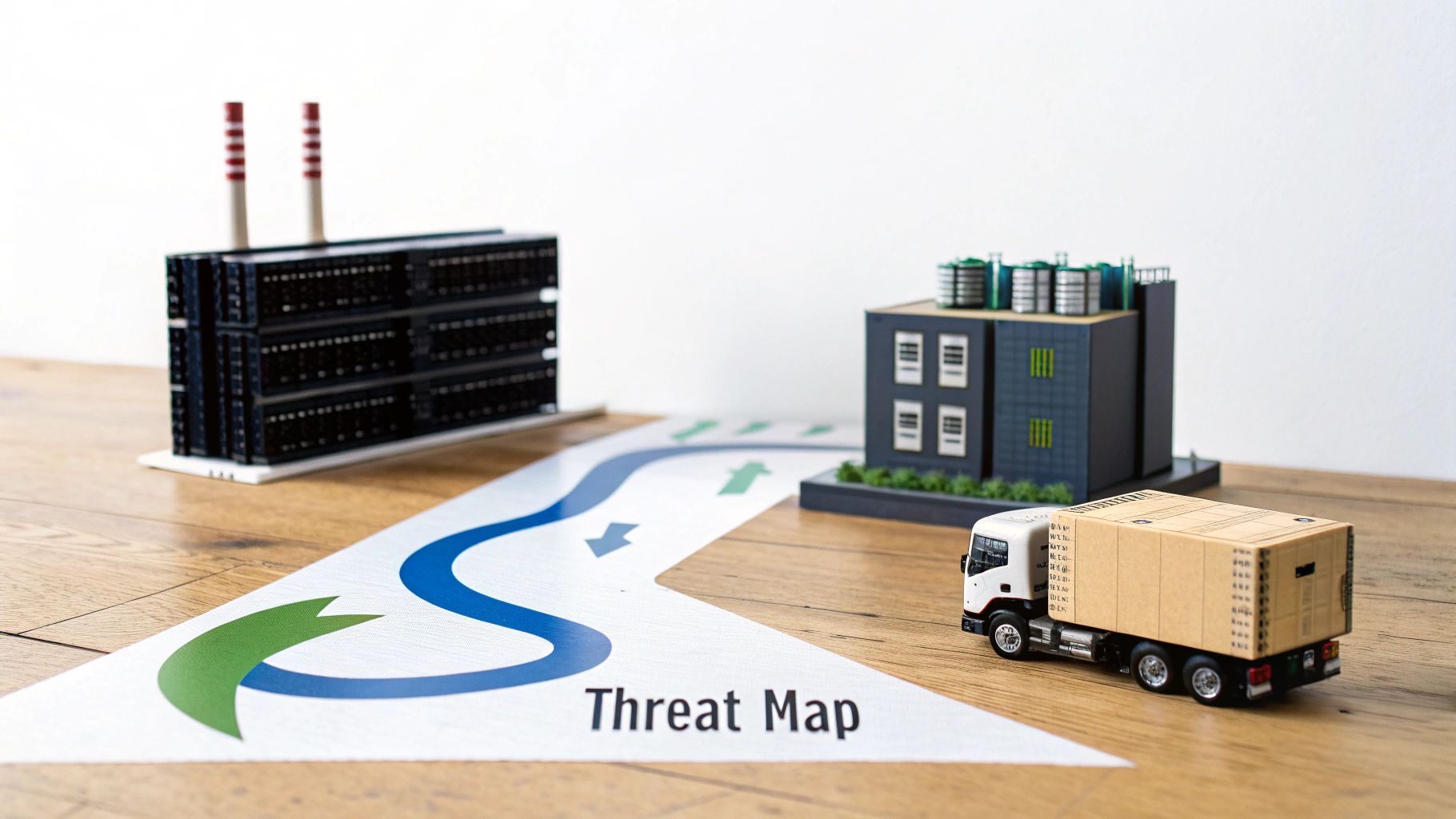
Before you can defend your AI, you have to know what you're up against. The world of AI application security isn't just a rehash of old cyber threats; it’s a whole new battlefield. A great way to get your head around the risks is to think of your AI system like a high-stakes supply chain.
Picture your training data as the raw materials. Your AI model is the factory where those materials get processed into something valuable. And your API? That’s the delivery truck that gets the finished product out to your users. A weak link anywhere in that chain can bring the whole operation down.
This isn’t just theory. The numbers show a clear trend: AI is becoming a go-to tool for cybercriminals. Some forecasts predict that 16% of all breaches in 2025 will involve AI-powered attacks, from hyper-realistic phishing scams to malware that outsmarts old-school antivirus. But there's good news, too. Companies that use AI for their own security have cut breach costs by an average of 34%, which translates to a savings of $1.9 million per incident. This highlights just how critical it is to understand AI's role as both a weapon and a shield. You can find more insights about AI's role in security incidents in recent industry analyses.
Securing the Raw Materials: Your Data Pipeline
Let's start at the beginning: the data pipeline. If an attacker messes with your raw materials, everything you build on top of them becomes unreliable. This is where a nasty threat called data poisoning comes into play.
Data poisoning is exactly what it sounds like—an attacker secretly injects bad data into your training set to create a hidden vulnerability. They might subtly feed the model biased information or flawed examples, teaching it to make specific mistakes on command. This can be incredibly difficult to detect, as the malicious data may constitute only a tiny fraction of the overall dataset.
It’s like someone contaminating a batch of flour with an ingredient that only reacts under certain conditions. The bread looks and smells fine, but it’s been compromised from the start. For your business, this could mean an AI loan application system starts discriminating against certain zip codes or a security model fails to identify a known threat actor. The insidious nature of data poisoning is that the model appears to function correctly until a specific trigger input is received, at which point it behaves in the attacker's intended way.
Protecting the Factory: The AI Model Itself
Next up is the factory—the AI model. This is where your secret sauce lives. It’s your intellectual property and the engine driving your application's value, which makes it a prime target for corporate espionage and manipulation.
Two big threats to watch out for here are:
- Model Evasion: This is all about tricking the model into making a mistake. Attackers craft specific inputs designed to fool your AI, like getting a fraud detection system to greenlight a suspicious transaction. These inputs, known as adversarial examples, are often imperceptibly different from legitimate inputs to a human observer but cause the model to produce an incorrect output.
- Model Inversion: Here, the goal is theft. By repeatedly sending queries to your model, an attacker can start to piece together what it was trained on or even reconstruct the model's architecture. It’s the digital equivalent of a rival buying your products and reverse-engineering them to steal your factory's blueprints. This can lead to the exposure of sensitive training data and the loss of a significant competitive advantage.
A compromised model doesn't just hurt your brand; it can lead to direct financial losses and hand your most valuable competitive advantage over to a rival. Securing the model is ground zero for effective AI application security.
Defending the Delivery Truck: Your Infrastructure and APIs
Finally, we have to lock down the delivery truck—the infrastructure and APIs that connect your AI to the outside world. This is where your application interacts with users, making it a hotspot for attacks.
The most common threat here is prompt injection. An attacker crafts a malicious prompt that hijacks the model's original instructions, essentially telling it to ignore its programming. This is like a hijacker showing your delivery driver a forged order to get them to hand over the cargo. The attacker can trick the model into bypassing its safety filters, leaking sensitive system information, or performing actions it was never supposed to. This attack vector is particularly prevalent with Large Language Models (LLMs) and can undermine the entire security posture of the application.
These vulnerabilities across the data, model, and infrastructure layers create a complex and interconnected threat landscape. To make it more concrete, the table below breaks down these common attack vectors and spells out what they could mean for your business.
Common AI Attack Vectors and Their Business Impact
Understanding the specific threats is the first step toward building a solid defense. Each vector targets a different part of your AI system, but all of them can have serious consequences for a startup or SMB.
| Threat Vector | What It Targets | Potential Business Impact |
|---|---|---|
| Data Poisoning | Training Data | Degraded model performance, biased outputs, and serious reputational damage. |
| Model Inversion | AI Model & Data | Theft of proprietary model architecture and sensitive training data. |
| Model Evasion | AI Model Logic | Bypassing security filters, incorrect classifications, and service manipulation. |
| Prompt Injection | Application API & Model | Data leaks, unauthorized actions, and bypassing of safety guardrails. |
As you can see, the impact goes far beyond a simple bug. These attacks can undermine user trust, expose you to liability, and destroy the very value your AI was built to create.
Building Security Into Your AI Development Lifecycle
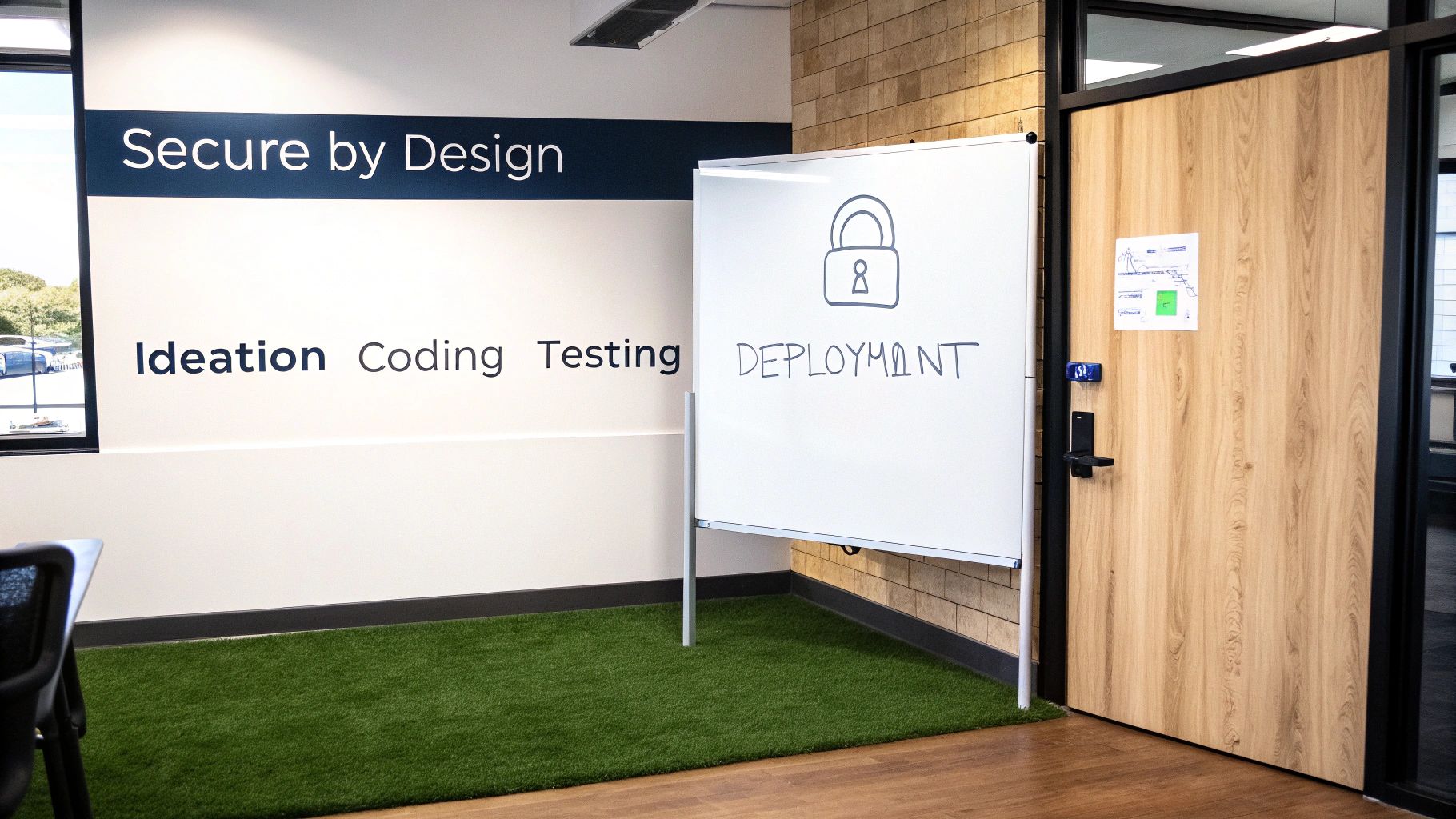
When it comes to AI application security, you can’t just bolt it on at the end and hope for the best. That’s like building a skyscraper and then trying to add the foundation. It doesn't work.
Instead, security has to be baked in from the very first design sketch. This “secure-by-design” philosophy, often called "shifting left," means you're thinking about potential threats at every stage of the AI lifecycle. It’s a continuous process, not a final checkbox, that results in an AI application that’s genuinely resilient and trustworthy. This approach integrates security considerations into ideation, data collection, model training, deployment, and monitoring, making security a shared responsibility across the entire team.
Start with AI-Specific Threat Modeling
Before your team writes a single line of code, you need to think like an attacker. Threat modeling is how you do it—it’s a structured way to identify potential risks, figure out how bad they could be, and plan your defenses.
For AI, this goes way beyond typical software vulnerabilities. You have to ask different, more specific questions during the design phase:
- How could an attacker poison our training data? This immediately makes you think about data pipelines, access controls, and where you’re sourcing your data from. You might consider data provenance checks and anomaly detection during data ingestion.
- What’s the worst that can happen if someone injects a malicious prompt? This forces you to get serious about input validation and output filtering for your model’s API. You might design strict sanitization layers or implement instruction defense mechanisms.
- Can someone reverse-engineer our model to steal it? This pushes you to design architectural defenses against model inversion and other IP theft attacks, such as rate limiting, query monitoring, and differential privacy techniques.
This simple exercise is one of the most powerful things you can do. It fundamentally changes your team’s mindset from just building features to building secure features.
Threat modeling is the difference between installing a smoke detector after a fire and building a house with fire-resistant materials from the start. One is a reaction; the other is a strategy.
Implement Robust Model Validation and Adversarial Testing
Once you start building, the focus shifts to proving the model actually does what you want it to—especially when it's under pressure. This is where model validation and adversarial testing come into play. It's like putting your AI through a boot camp designed to find every weak spot.
Model validation is the baseline. You test the model against clean, unseen data (a holdout set) to confirm its accuracy, fairness, and generalization capabilities, ensuring it’s not exhibiting unwanted biases. But that only tells you how it performs under perfect, cooperative conditions.
Adversarial testing is the real fire drill. Here, you intentionally try to break your model. You feed it cleverly disguised inputs designed to make it fail spectacularly. For an image model, you might tweak a few pixels in a photo to trick it into seeing a car instead of a cat. For an LLM, you’d craft clever prompts designed to bypass its safety filters. This practice, often called "red teaming," is essential for understanding the model's resilience against malicious users.
The point isn’t just to break the model, but to understand how and why it breaks. This process shines a light on blind spots you’d otherwise never find, allowing you to harden your model's defenses through techniques like adversarial training. It's a core practice for building resilient systems, a concept we dig into in our guide to DevOps for machine learning.
Automate Security in Your CI/CD Pipeline
Finally, to make all of this scalable, you have to automate it. Security can't rely on manual checks, which are slow and prone to human error. By embedding security tools directly into your Continuous Integration/Continuous Deployment (CI/CD) pipeline, it becomes a seamless part of every single code change.
Here are the key automated practices to build in:
- Dependency Scanning: Your project likely depends on dozens of open-source libraries. Tools like Snyk or GitHub's Dependabot can be set up to automatically scan every dependency for known vulnerabilities, alerting you the moment a new one is found.
- Static Application Security Testing (SAST): These tools are like a spell-checker for security flaws. They analyze your source code before it runs, catching common mistakes that could open the door to an attack.
- Secrets Management: API keys, database passwords, and other credentials should never, ever be hardcoded in your source code. Use a dedicated secrets manager like HashiCorp Vault or AWS Secrets Manager to inject them securely at runtime.
By weaving these automated checks into your development workflow, AI application security stops being a one-time event and becomes a continuous, ingrained habit that protects your product from day one.
Hardening AI Systems for Production Environments

Pushing an AI model from the safety of a development environment into a live production setting is where the rubber really meets the road. This is the moment your application faces real-world attacks, and it's a critical "last mile" that requires a smart blend of MLOps and DevSecOps thinking. Your goal is to build a system that's not just powerful, but also resilient and secure at scale.
Think of it this way: you're no longer just building a secure model, you're now operating a secure live service. It’s like assigning a dedicated security detail to your AI as soon as it goes public. This means locking down every potential entry point, continuously watching for trouble, and knowing exactly what to do when something goes wrong.
A huge blind spot for many companies is the rise of "Shadow AI," where employees use unapproved AI tools without any security oversight. This creates massive governance gaps. Some reports show that a staggering 60% of organizations don’t have any formal AI policy in place. This unchecked experimentation is a recipe for disaster, with 20% of firms already reporting breaches from shadow AI. These incidents lead to sensitive data leaks and add an average of $670,000 to the cost of a breach. You can read more about these AI security predictions and what they mean for businesses.
Implement the Principle of Least Privilege
The golden rule of production security has always been the principle of least privilege. It’s a simple idea: every part of your system, from an API to a database, should only have the absolute minimum permissions required to do its job. Nothing more.
For your AI application, this needs to be applied with surgical precision:
- API Access Controls: Don't leave your model's API wide open. Use role-based access control (RBAC) to define exactly who can query the model and what they can do. An internal analytics dashboard might only need read-only access to predictions, while a lead engineer needs permission to kick off a retraining job. Implement rate limiting to prevent abuse and model inference attacks.
- Data Access Scopes: The production model should never, ever have direct access to your full raw training dataset. It only needs to connect to the specific, sanitized data sources required for inference. This simple step dramatically contains the blast radius if the model itself is ever compromised. The connection strings and credentials should be managed securely, never exposed to end-users.
Applying least privilege is like giving every employee a keycard that only opens the specific doors they need for their job. It’s a foundational concept that shrinks your attack surface by ensuring one compromised component can't give an attacker the keys to the entire kingdom.
Establish Comprehensive Monitoring and Observability
You can't protect what you can't see. In a live environment, monitoring is your first line of defense, giving you the visibility to spot an attack as it happens. For AI application security, this goes way beyond checking server health. It's about having deep observability into the model's behavior.
Effective AI monitoring means tracking a few key security-focused metrics:
- Input and Output Analysis: You should be logging and analyzing the prompts coming in and the responses going out. Be on the lookout for sudden spikes in bizarre or malicious-looking inputs—these are classic signs of an evasion or prompt injection attack. Establishing a baseline of normal traffic patterns is critical for anomaly detection.
- Data Drift Detection: Continuously monitor the live data being fed to your model and compare its statistical profile to your training data. A significant deviation, or drift, not only degrades performance but could also be a red flag for a data poisoning attempt or an evolving user environment that the model is not equipped to handle.
- Model Performance Metrics: Keep a close eye on your core performance metrics like accuracy, latency, and error rates. An unexpected nosedive in performance might be the first clue that an adversary is actively manipulating your model or that the model's effectiveness is decaying over time.
This level of detail is what helps you spot anomalies that traditional security tools would completely miss. To learn more about this, check out our guide on choosing the right machine learning model monitoring tools.
Create a Robust Incident Response Plan
No matter how strong your defenses are, security incidents can still happen. The difference between a minor hiccup and a full-blown crisis is a clear, well-rehearsed incident response plan. When an alert goes off at 2 AM, your team needs a playbook, not a frantic brainstorming session.
Your AI-specific incident response plan should outline clear steps for various threat scenarios:
- Isolate the System: The first move is always to stop the bleeding. Immediately revoke access to the compromised model or API endpoint to prevent further damage. This could involve rerouting traffic to a standby model or enabling a maintenance mode.
- Analyze the Attack: Dig into your monitoring logs to piece together what happened. Was it a sophisticated prompt injection? Did they exploit a vulnerability in a third-party library? A detailed forensic analysis is crucial for understanding the root cause.
- Deploy a Safe Model: Always have a previously validated, secure version of your model on standby. This lets you deploy a hotfix quickly to restore service with a known-good configuration while you investigate the compromised version.
- Remediate and Report: Once the immediate fire is out, fix the root cause. This could mean patching a library, improving your input sanitization, or even retraining the model on hardened data. Finally, document everything to learn from the incident and update your security protocols.
Should You Build or Buy Your AI Security?
Every startup runs on a finite budget of time and focus. As you build your AI-powered product, you’ll hit a major crossroads: do you pour precious resources into building an AI application security team from the ground up, or do you bring in a specialist partner?
This isn't just a technical detail; it’s a foundational business decision. Get it wrong, and you could be looking at crippling launch delays, compliance headaches, or a security breach that kills your company before it even gets started. But if you get it right, your team can stay laser-focused on building an incredible product, confident that it’s secure by design.
Key Questions to Guide Your Decision
Before you jump one way or the other, you need to take an honest look at your company's real-world capabilities, goals, and how much risk you're willing to stomach. Answering these questions will help you make a strategic choice, not an accidental one.
Start with a no-fluff evaluation of what you have in-house.
- Real Team Expertise: Does your team have actual, hands-on experience with AI-specific threats like prompt injection and model evasion? Or is their background mostly in traditional web app security? The two are very different beasts.
- Regulatory Heat: Are you working in a heavily regulated space like healthcare (think HIPAA) or finance? Handling data from EU citizens (GDPR)? Compliance isn't a "nice-to-have," and the penalties for messing it up are severe.
- Model Complexity: Is your AI a straightforward classifier, or is it a complex, multi-modal beast with a huge and tangled attack surface? The more intricate the model, the more specialized the security needs to be.
- Time to Market: How fast do you need to launch? Building a security practice from scratch is a massive time sink that can easily push your go-to-market date back by months.
The answers here will quickly tell you whether a DIY security plan is realistic or if finding a partner is the smarter move.
Generative AI has turned the security world upside down. A recent analysis projects that by 2026, employee use of AI tools will have tripled. The downside? Data policy violations are set to double, and the average company will face a shocking 223 AI-related data security incidents every single month. A huge driver of this is "shadow AI"—teams using unauthorized apps and leaking data all over the place. You can get more insights on this emerging AI data security crisis from the team at Kiteworks.com.
Weighing the Pros and Cons
Both building your own team and hiring a managed service have clear upsides and downsides. The right call depends entirely on your situation, resources, and priorities. Going the DIY route gives you total control, but it also saddles you with total responsibility. On the other hand, a partner like Vibe Connect gets you secure much faster but means relying on an external team.
To make this decision easier, it helps to see a direct comparison of the trade-offs involved.
DIY Security vs. Managed Partner: A Strategic Comparison
Choosing between building an in-house team and hiring a partner is one of the most important early decisions for an AI startup. The table below breaks down the key differences to help you evaluate which path aligns with your business goals, resources, and timeline.
| Consideration | DIY Approach (In-House Team) | Managed Partner (e.g., Vibe Connect) |
|---|---|---|
| Upfront Cost | High—You're on the hook for recruiting expensive talent, buying tools, and ongoing training. | Lower—Predictable subscription costs without the huge initial cash outlay. |
| Time to Implement | Slow—It can easily take months to hire the right people, define your processes, and get tools in place. | Fast—You tap into their existing expertise and infrastructure to harden your security almost immediately. |
| Expertise & Focus | Limited—Your team has to split its attention between building the product and becoming security experts. | Deep—You get a dedicated team of specialists who live and breathe AI security all day, every day. |
| Scalability | Challenging—As you grow, scaling your security team means constantly hiring and allocating more resources. | Seamless—A good partner is built to scale their services right alongside your application's growth. |
| Accountability | Internal—When something goes wrong, the buck stops with you. All breaches and compliance failures are on your team. | Shared—The partner takes on direct responsibility for security audits, monitoring, and incident response. |
Ultimately, this choice boils down to a fundamental trade-off: control versus focus.
If you're a well-funded company with a strong security culture already baked in, building your own team could be a smart long-term play. But for most startups and SMBs, speed and product are everything. In that case, teaming up with a specialist is the fastest, most efficient way to secure your AI application without losing your momentum.
Your AI Security Questions, Answered
Let's be honest: navigating the world of AI security can feel like a maze, especially when you're laser-focused on just getting your product out the door. To cut through the noise, I've put together answers to the questions I hear most often from founders, developers, and product managers. The goal here is to give you clear, straightforward advice you can actually use to build safer, more trustworthy AI from day one.
Think of this as your quick-start guide for tackling those nagging security concerns, whether you're just sketching out your first AI feature or you're already on the path to deployment.
What’s the Biggest AI Security Mistake Startups Make?
The most common—and frankly, most dangerous—mistake is assuming AI security is just a new flavor of traditional app security. So many teams think their existing firewalls, input sanitizers, and web security playbooks are enough to cover their new AI features. That assumption creates a massive, critical blind spot.
Traditional security is great at defending against known threats like SQL injection or cross-site scripting. It was built for that world. But it’s completely unprepared for the unique ways AI systems can be attacked, like data poisoning, model evasion, or the prompt injection attacks we're seeing everywhere now.
For example, your web application firewall might easily block a malicious code snippet. But it won't have a clue that a seemingly harmless user query is actually a "jailbreak" prompt designed to trick your LLM into ignoring its own safety rules and spitting out confidential system data. It’s a totally different kind of threat.
The only real solution is to build an AI-specific security mindset right from the start. This means your threat modeling has to explicitly account for adversarial AI attacks. It also means you need serious validation and filtering for any input that touches the model directly, not just the code wrapped around it.
How Can a Non-Technical Founder Gut-Check Their AI Security?
You absolutely do not need a computer science degree to ask the right questions and get a real sense of your product's security. As a non-technical founder, you can cut through the complexity by focusing on the core principles instead of getting lost in the weeds.
The best way to do this is to have a frank conversation with your development team. Here are four questions to get you started:
- "How are we protecting our training data, both when it's stored and when it's moving?" This gets right to the heart of data privacy and the risk of data poisoning. A good answer will involve things like encryption and very strict access controls.
- "What are we doing to stop prompt injection or other ways someone could manipulate our model?" This is all about protecting the model's integrity. You're listening for answers that mention input validation, output filtering, and instruction defense.
- "Do we have a way to spot weird model behavior or outputs as they happen?" This is the runtime security piece. A confident answer will talk about logging, anomaly detection, and setting up alerts.
- "How are we controlling who—or what—can access our AI models and their APIs?" This is a direct shot at infrastructure security. The answer should cover authentication, authorization, and the principle of least privilege.
Pay close attention to how they answer. The clarity and confidence they have, without hiding behind a wall of jargon, will tell you a lot about how seriously they're taking ai application security.
When Should I Actually Start Worrying About AI Security?
The absolute best time is at the very beginning—the idea stage, long before anyone has written a single line of code. This "shift-left" philosophy isn't just some buzzwordy best practice; it's a strategic imperative.
It is so much cheaper and more effective to build security in from the start than to try and bolt it on later. When security is an afterthought, you almost always find that fixing core vulnerabilities means ripping apart your architecture, which leads to painful delays and expensive rework.
Waiting until you’re about to launch to think about security is a recipe for disaster. By that point, critical flaws can be so baked into your application that fixing them is either impossible or just too expensive and time-consuming.
Here’s a simple way to think about how security fits into each stage:
- Design Phase: This is where you do AI-specific threat modeling. You anticipate risks like data poisoning or model evasion before they get built into the system.
- Development Phase: Your team should be using secure coding practices, managing secrets properly, and scanning for vulnerabilities in all your dependencies.
- Testing Phase: Go beyond basic QA. This is when you perform adversarial testing—actively trying to break your model to see where its weak spots are.
Even if you're just building a Minimum Viable Product (MVP), basic security hygiene like strict access controls and sanitizing prompts can shut down a whole class of common attacks and give you a solid foundation to build on.
Are Open-Source AI Models Less Secure?
This question comes up all the time, and the answer isn't a simple yes or no. Open-source models aren't inherently less secure, but they do come with a different set of risks. In reality, the security of your app has far more to do with how you implement and manage the model than where it came from.
With open-source models, the big win is transparency. You can actually look under the hood at the model's architecture and, in some cases, its training data. But that transparency is a double-edged sword. When vulnerabilities are found, they become public knowledge for everyone—good guys and bad guys alike. The responsibility for securing, patching, and maintaining that model is 100% on your team.
Proprietary models from providers like OpenAI or Google come with the backing of huge, dedicated security teams. That’s a major plus. The trade-off is that they often operate like "black boxes," giving you very little insight into how they work or what data they were trained on. You're basically placing your trust in their security practices.
At the end of the day, your choice of model is far less important than your security practices. Secure deployment protocols, rigorous input validation, continuous monitoring, and a solid incident response plan are non-negotiable, no matter which path you choose.
Ready to turn your ambitious AI idea into a production-ready, secure product without getting bogged down by deployment and security hurdles? At Vibe Connect, we combine AI-driven code analysis with a team of seasoned experts to manage the hard parts of shipping software—from secure deployment and scaling to rigorous security audits. Focus on your vision, and let us connect it with flawless execution.
Learn more about how Vibe Connect can accelerate your journey from idea to impact.