

Validating your startup idea is about one thing: getting proof that people actually want what you’re planning to build before you build it. It's a structured way to test the major assumptions you're making about a customer's problem and your brilliant solution, so you don't pour your heart, time, and money into something nobody will buy. This process isn't about slowing you down; it's about making sure you're running at full speed in the right direction.
Why Most Startups Fail and How Validation Flips the Script
Every founder starts with a great idea—a vision for something that could genuinely make a difference. But passion and a great concept don't guarantee success. The path from idea to a thriving business is a minefield of risks, and the biggest one isn't a technical glitch; it’s building the wrong product from the start.
The Sobering Reality of Startup Failure
Let's look at the numbers, because they tell a powerful story. Roughly 90% of all startups fail. That's a tough pill to swallow. Digging deeper, about 10% don't even make it past their first year, and a massive 70% fail somewhere between year two and year five.
A global survey really hit the nail on the head, finding that the number one reason startups die—accounting for 42% of failures—is a misread of market demand. In other words, they built something nobody truly needed.
The data is crystal clear. Startups don't usually fail because of bad code or a lack of funding. They fail because they create a perfect solution for a problem that isn't a real problem, isn't painful enough for people to care about, or isn't something they'd ever pay to fix.
Shifting from a "Builder" to a "Learner"
This is exactly why validation is your secret weapon. It forces you to completely change your perspective. Stop thinking like a builder who's obsessed with features and code. Instead, you need to start thinking like a scientist who's obsessed with learning and finding evidence.
Your brilliant idea isn't a fact; it's a hypothesis. Everything about your business—your target customer, your pricing, your channel—is just an assumption waiting to be proven wrong. The whole point of validation is to test these assumptions methodically, using the least amount of time and money possible.
The Validation Mindset: From Assumption to Evidence
| Common Founder Assumption | Validation Question to Answer | Example Validation Method |
|---|---|---|
| "I know my target customer will love this feature." | Do they actually care about this problem enough to seek a solution? | Customer discovery interviews to uncover their biggest pain points. |
| "People will definitely pay $50/month for this." | What is the perceived value of this solution to the customer? | A landing page smoke test with tiered pricing options. |
| "If we build it, they will come." | Where do my potential customers hang out, and how can I reach them? | Run small-scale ads on LinkedIn or Reddit targeting specific groups. |
This table shows how validation forces you to swap gut feelings for real-world data at every turn.
The crucial mindset shift is from asking, "Can we build this?" to asking, "Should we build this?" The first question is about your technical skills; the second is about your business's survival.
This evidence-first philosophy de-risks your entire venture, one step at a time. It ensures that when you finally do go all-in on development, you're not just hoping for the best. You're building on a solid foundation of proven customer demand. This approach also helps you sidestep building up the wrong kind of technical debt. To learn more, check our guide on how to reduce technical debt, which often piles up when teams build features without clear validation.
Lay the Groundwork: Your Validation Framework
Okay, let's pump the brakes on coding. Before a single line of code gets written, you need a solid plan. I've seen too many founders jump straight into building, only to find out months later that nobody wants what they’ve built.
Great validation isn't about just asking your friends if they like your idea. It’s a structured, almost scientific process of de-risking your entire venture. This means taking that brilliant concept in your head and breaking it down into a set of clear, testable hypotheses.

Think of your idea as a bundle of core assumptions. These are the things that absolutely must be true for your business to have a fighting chance. Our job here is to identify those assumptions, figure out which ones could kill your startup fastest, and then design cheap, quick experiments to see if they hold water. This whole process creates a roadmap for learning.
Get It on Paper with a Lean Canvas
First, get your idea out of your head and onto a Lean Canvas. It’s a one-page business plan that forces you to be concise. Instead of getting lost in a 30-page document, you get a high-level snapshot of your business model, broken into nine essential blocks. For early validation, focus on these five boxes:
- Customer Segments: Who, exactly, are you building this for? "Everyone" is not an answer.
- Problem: What are the top 1-3 burning problems these specific people have?
- Unique Value Proposition (UVP): In a single, clear sentence, what makes you different and worth their attention?
- Solution: What are the top 1-3 features that directly solve their problems?
- Revenue Streams: How will you actually make money from this?
Filling this out is an exercise in clarity. It shines a bright light on all the things you think you know but don't have proof for yet. Each box is a major assumption.
Pinpoint Your Riskiest Assumptions
With your Lean Canvas complete, it's time to play devil's advocate. Your job is to find the assumptions that, if wrong, would make your entire idea collapse. Founders often get fixated on the solution, but that's rarely the biggest risk.
The make-or-break question isn't "Can we build this?" It's almost always "Do enough people actually care about this problem to pay for a solution?" Getting that wrong is a fatal, and very common, startup error.
Look at your canvas and ask yourself: which of these assumptions has the least amount of real-world evidence backing it up and would have the greatest negative impact if it were false? That’s your starting point.
Turn Assumptions into Testable Hypotheses
Now, let's turn those risky assumptions into simple, testable statements. A good hypothesis is specific, measurable, and can be proven either true or false.
Let's walk through an example. Imagine you want to build a SaaS tool to help freelance designers automate their client onboarding process.
- Your Big Assumption: "Designers waste a ton of time on client onboarding."
- Your Testable Hypothesis: We believe that freelance designers spend over 5 hours per month on manual onboarding tasks like sending contracts, chasing down assets, and scheduling kickoff calls.
Let's try another one.
- Your Big Assumption: "Designers will pay for a tool that saves them time."
- Your Testable Hypothesis: We believe at least 15% of designers who see a landing page for our automated onboarding tool will sign up for the waitlist.
These clear, measurable hypotheses give you a target to aim for in your validation experiments. Nail this framework down first, and it will make all your technical decisions much simpler later on. In fact, knowing your business inside and out is the first step in figuring out how to choose a tech stack for your product.
Getting Out of the Building to Uncover Real Insights
You've mapped out your riskiest assumptions. Now comes the hard part: getting out of your own head and into the real world. We’re moving from spreadsheets and theories to actual conversations with potential customers. The mission is simple but crucial: find out if the problems you think people have are real, urgent, and painful enough for them to open their wallets. The only way to do that is to talk to them.
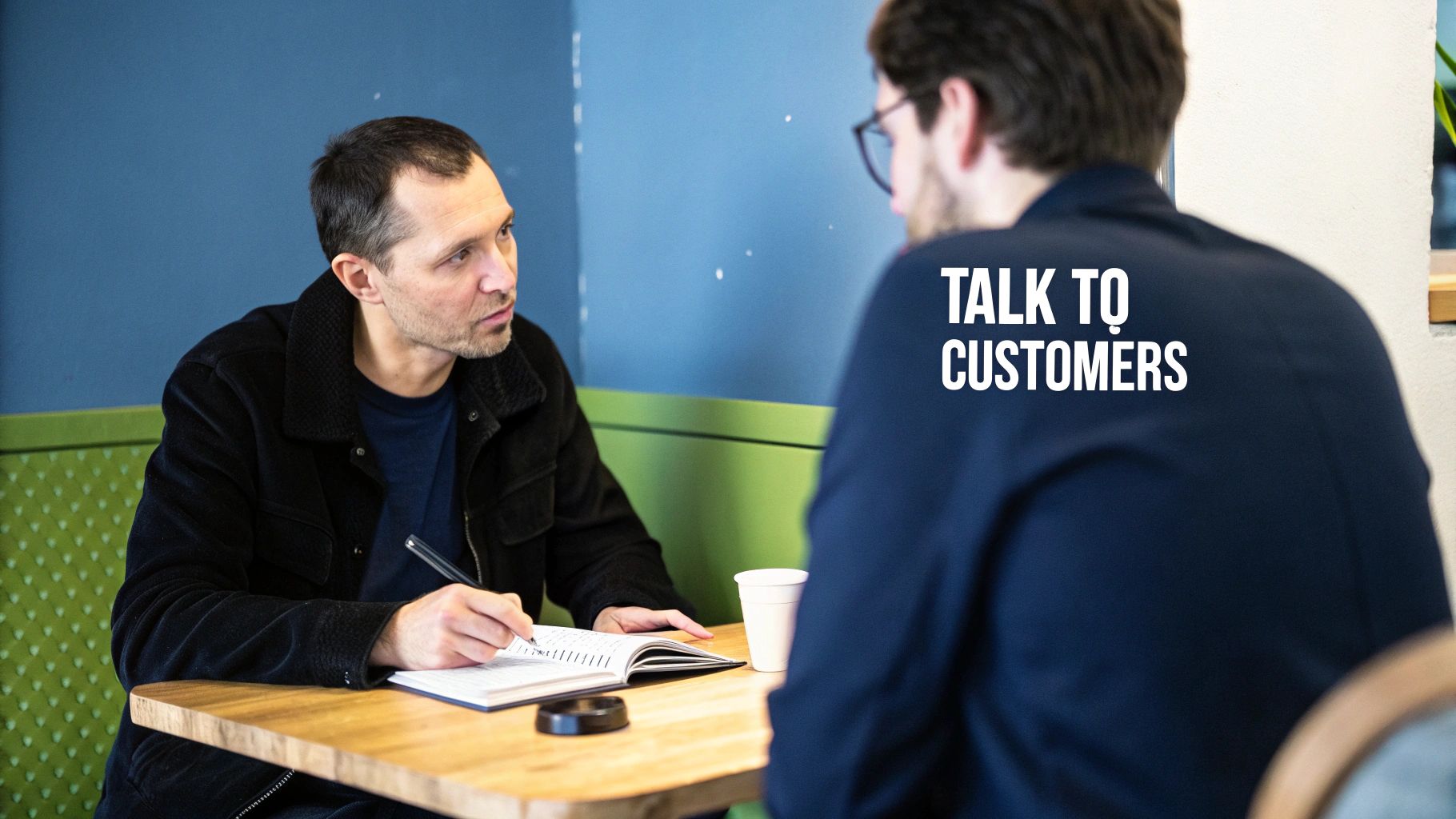
This whole process is called customer discovery. Think of it as detective work, not a sales pitch. You're not trying to sell your idea; you're trying to understand their world and their problems. Your job is to listen, not to talk.
Finding the Right People to Talk To
Your first instinct will be to pitch your idea to friends and family. Resist this urge. They love you, which means they're biased. They’ll likely tell you what you want to hear. This "niceness gap" is a startup killer, giving you a dangerously false sense of security. You need to talk to strangers who fit your ideal customer profile. Here's where to find them:
- LinkedIn Search: This is an absolute goldmine. Use the advanced search to zero in on people by job title, industry, or company size.
- Niche Online Communities: Go where your customers already are. Think specialized subreddits (like r/freelance), private Slack channels, Discord servers, or industry-specific Facebook groups.
- Your Competitor's Audience: Look at who follows your potential competitors on social media. These people have literally raised their hands and said, "I am interested in solving this problem."
When you reach out, keep it short, sweet, and respectful of their time. A simple message like, "Hi [Name], I'm researching the challenges freelance designers face with client onboarding. Would you be open to a 20-minute chat to share your experience?" works surprisingly well.
How to Run a Problem-Focused Interview
Once you get someone on a call, your questioning technique is everything. Your goal is to get them telling stories about their past, not speculating about the future.
The most dangerous question in any startup is, "Would you use a product that did X?" The answer is almost always a polite "yes," which tells you absolutely nothing. It's a vanity metric.
Instead, ground the conversation in real, past experiences.
- BAD Question: "Would you pay for a tool to automate client onboarding?"
- GOOD Question: "Tell me about the last time you onboarded a new client. Could you walk me through that process step-by-step?"
The second question opens the door to a story. As they start talking, you can dig deeper with follow-ups like "What was the most frustrating part of that for you?" and "Have you ever gone looking for a tool or service to help with this?" Listen for the emotion. When you hit a real pain point, you'll hear the frustration in their voice.
Lightweight Experiments to Run Without a Product
Customer interviews provide rich, qualitative feedback. But you should also run simple experiments to get some hard numbers on demand—long before you write a single line of code.
- The Smoke Test Landing Page: A classic for a reason. Spin up a simple one-page website that nails your value proposition. Use a tool like Carrd or Webflow to make it look sharp. Have one clear call-to-action: "Join the Waitlist." The metric you're watching is the visitor-to-signup conversion rate.
- The Concierge Test: This is my personal favorite. Instead of building the software, you become the software. For our designer onboarding tool, you'd manually handle the entire onboarding process for a few paying clients. It’s not scalable, but the hands-on learning is priceless. This is the ultimate way of how to validate a startup idea because it proves people will pay for the outcome, not just the fancy tech.
Building the Right MVP to Test Your Core Solution
Alright, you've done the interviews, run some smoke tests, and the early signals are looking good. Now it’s time to move from talking about your solution to actually building it. But hold on—this isn't about building your magnum opus. It's about crafting a Minimum Viable Product (MVP), a lean, strategic tool built for one thing: learning.
Think of your MVP not as a watered-down version of your final product, but as a scientific experiment. Its only job is to get a real, functional solution into the hands of your first users to see if your core idea actually holds water. This is the moment you shift from validating the problem to validating your solution.
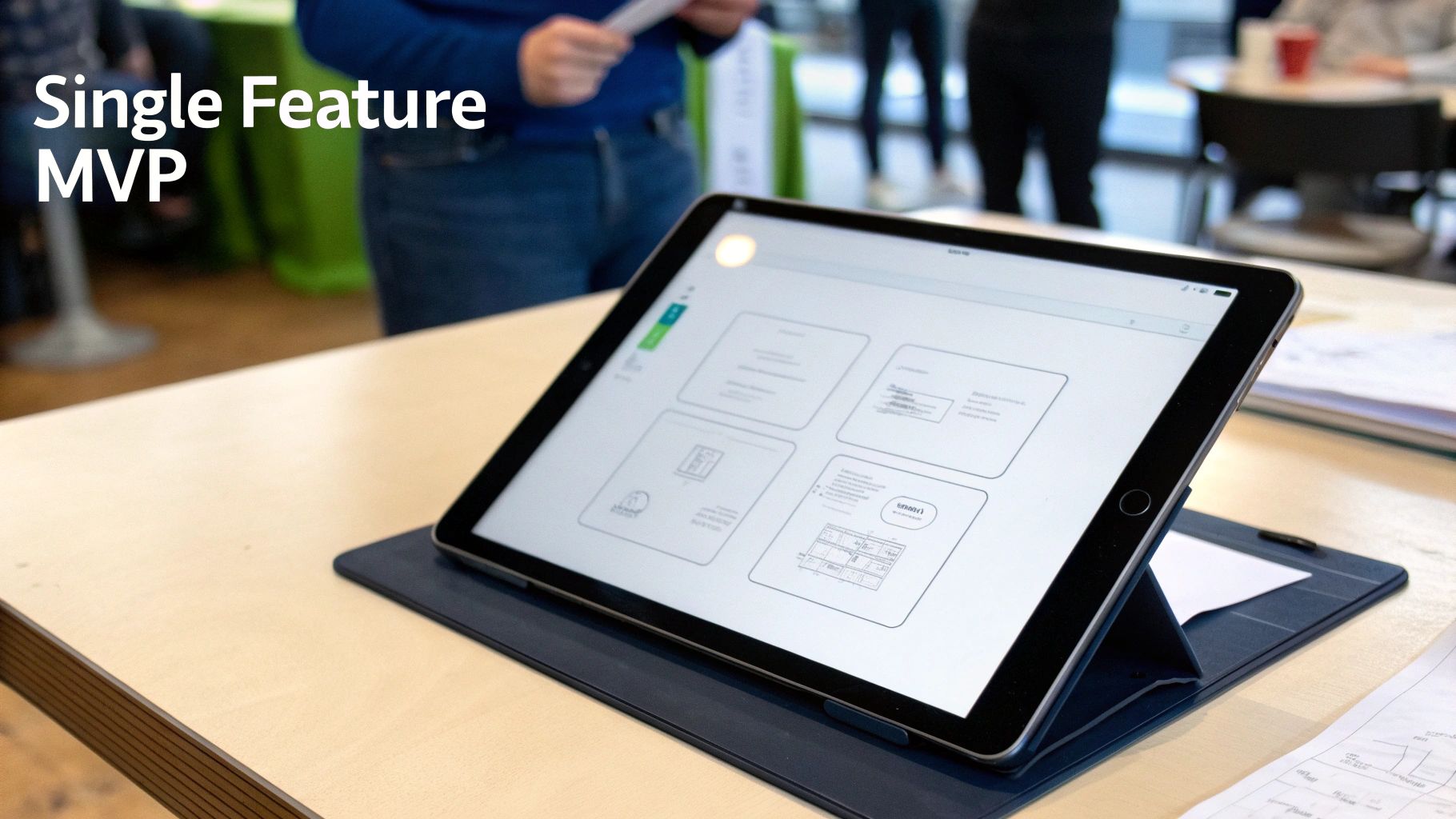
This entire stage comes down to one skill: ruthless prioritization. You have to pinpoint the one feature that solves the most painful part of your customer's problem and have the discipline to cut everything else.
Define Your "One Thing"
The entire point of an MVP is to answer a single, make-or-break question: "If we deliver this core value, will people actually use it?" To get a clear answer, you need to isolate the absolute, must-have function of your product.
Just look at how some of the giants started:
- Dropbox: The first MVP wasn't a product at all. It was a simple video showing how file syncing would work. They sold the dream and validated demand before writing a line of production code.
- Zappos: Nick Swinmurn didn't build a massive e-commerce platform. He took pictures of shoes at local stores, posted them online, and when an order came in, he physically went to the store to buy and ship them. He was testing one simple hypothesis: will people buy shoes online?
Now it's your turn. What’s the smallest possible thing you can build that delivers a truly meaningful result for a user? For more guidance on this phase, our articles on the journey from an MVP to a full Version 1.0 break it down further.
Choose the Right Kind of MVP for Your Idea
Not all MVPs are built with code. The best approach depends on what you’re trying to build and what you need to learn. There's a brutal reality here: 42% of failed projects die because they lack product-market fit. Interestingly, research shows that the most successful startups often nail this before building a high-fidelity MVP.
The purpose of an MVP isn't just to build a product; it’s to build a feedback loop. Your goal is to get something into users' hands quickly, measure their behavior, and learn what to build next.
This mindset is what separates founders who build what people want from those who build what they think people want.
Choosing Your MVP Type
To help you decide which path to take, here’s a quick breakdown of common MVP approaches. Each one is designed to test a different kind of assumption with varying levels of effort.
| MVP Type | Best For Validating | Resource Cost | Example |
|---|---|---|---|
| No-Code App | Workflow and feature utility | Low-Medium | Building a functional internal tool with a platform like Bubble or Softr to test if your team adopts the workflow. |
| Figma Prototype | User experience and navigation flow | Low | Creating a clickable prototype of a mobile app in Figma to see if users can successfully complete a core task without confusion. |
| Single-Feature App | Core value proposition and technical feasibility | Medium-High | A simple web app that does one thing exceptionally well, like converting a PDF to a specific format, to prove demand for the core function. |
| Concierge MVP | Service demand and user needs | Low | Manually onboarding the first 10 clients for a B2B SaaS product, using email and spreadsheets to deliver the service. |
Picking the right MVP is a critical decision in how to validate a startup idea. It ensures you’re testing your biggest risk with the least amount of waste, giving you the hard data you need to confidently decide what to do next.
Measuring What Matters to Signal a Green Light
So, you've run your experiments and now you're sitting on a pile of data. The real test isn't just collecting data; it's about understanding what it's telling you. You have to learn how to separate the meaningful signals from the distracting noise.
This is a classic founder trap. We get hooked on vanity metrics—things like website traffic or social media likes. They look good on a chart, but they don't tell you if you have a business. We need to dig deeper for the actionable metrics, the numbers that reflect genuine customer commitment.
Moving Beyond Vanity Metrics
A "like" is not a commitment. True validation comes when people are willing to give you something of real value in exchange for your proposed solution. That value doesn't always have to be money at first. Think about it in terms of:
- Time: Are they willing to sit through a 30-minute demo or give feedback on a prototype?
- Reputation: Would they risk their professional standing by referring a colleague to your waitlist?
- Money: This is the ultimate test. Are they willing to commit to a pre-order or sign up for a paid pilot?
These are the real currencies of interest. Focusing on them will keep you grounded.
Key Quantitative Metrics to Track
When you're running validation experiments, you need to set clear, objective benchmarks. Founders who are methodical about validation have a 60% higher chance of success. Your landing page conversion rate is a huge tell. Industry benchmarks suggest that for startup campaigns, a conversion rate over 20% is a strong signal you're onto something, as noted on the Glorium Technologies' blog.
Here are a few other critical numbers to keep your eyes on:
- Waitlist Signup Conversion Rate: Hitting 10-15% is a solid signal of interest. If you're cracking 20% or more, that’s exceptional.
- Pre-Order Commitments: Getting someone to pull out their credit card for a product that doesn't exist yet is the strongest validation signal you can get. Set a practical goal, like getting 20 pre-orders.
- Early User Retention Rate: Once your MVP is out, do people come back? For a very early-stage product, a week-one retention rate of 20-30% is a fantastic sign.
A common mistake is looking at these numbers in a vacuum. A sky-high conversion rate but zero pre-orders tells a specific story: your message is compelling, but the value isn't strong enough yet for people to pay.
Analyzing Qualitative Feedback for Deeper Insights
Numbers tell you what is happening, but qualitative feedback tells you why. The conversations and survey responses you get from potential customers are just as critical. Your job is to become a pattern recognition machine.
- Recurring Pain Points: Are multiple people describing the exact same problem, sometimes using the same phrases?
- "Take My Money" Moments: When you hear things like, "Seriously, when can I use this?" or "I needed this yesterday," you've struck gold.
- Feature Requests: If you keep hearing requests for the same specific capability, it's a strong clue for what to prioritize.
I always recommend a simple spreadsheet to track this. Make a row for each piece of feedback and tally every time a specific pain point comes up. By the time you’ve done 10-15 interviews, a clear hierarchy of what people actually care about will emerge.
Common Sticking Points in Startup Validation
Even with a solid plan, the validation process can feel murky. It’s completely normal to have questions pop up along the way. Here are some of the most common ones I hear from founders, with straight-up answers to help you get unstuck.
How Do I Know When It’s “Validated Enough”?
There's no giant "VALIDATED" stamp that falls from the sky. Instead, you're looking for a convergence of signals. On the quantitative side, you should be consistently hitting the success metrics you set for yourself. Is that landing page still getting a 15% conversion rate? Did you hit your pre-order goal? But the qualitative signals are just as critical. It's when the conversation shifts, and they stop answering your questions and start asking their own, like, "This is incredible. When can I get my hands on it?"
Ultimately, the strongest signal you can get is commitment. When someone is willing to give you their time for a long demo, their reputation by referring a colleague, or their actual money in a pre-sale, you're onto something real.
What if My Validation Results Are Terrible?
First, celebrate. I'm serious. A negative result isn't a failure; it’s a massive win. You just saved yourself time and money building something nobody wanted. Your job now is to play detective and figure out the "why." Was it the wrong audience? Not a real pain? A confusing message? Now you can pivot—making a major change to a core assumption—or iterate by making a smaller tweak. Either way, you form a new, smarter hypothesis and run another small, fast experiment.
Can I Actually Do This With No Money?
Absolutely. Some of the most powerful validation techniques are either free or ridiculously cheap. Customer discovery interviews only cost your time. You can spin up a great-looking landing page on Carrd for less than a couple of fancy coffees. A hyper-targeted ad campaign on Reddit or LinkedIn can give you invaluable data for under $100. You can even mock up a realistic prototype using the free version of a design tool like Figma.
How Do I Avoid Just Hearing What I Want to Hear?
This is the biggest trap for any founder—confirmation bias. You have to actively fight this instinct. The single best way to do this is to ground your questions in the past and present, not the hypothetical future.
- Don't ask: "Would you pay for a tool that did X?"
- Instead, ask: "Tell me about the last time you ran into this problem. What did you actually do?"
This gets you stories about real behavior and existing budgets. Finally, adopt a skeptic's mindset. Your mission isn't to prove your idea is brilliant; it's to try your absolute best to kill it. This detective-like stance is your best defense and a crucial part of learning how to validate a startup idea the right way.
Once you've got that green light, the challenge shifts to turning your validated idea into a real, production-ready product. This is where Vibe Connect comes in. Our mix of AI agents and expert "Vibe Shippers" takes on the heavy lifting of deployment, scaling, and security, so you can focus on your customers and your vision. See how we help connect great ideas with flawless execution at https://vibeconnect.dev.