

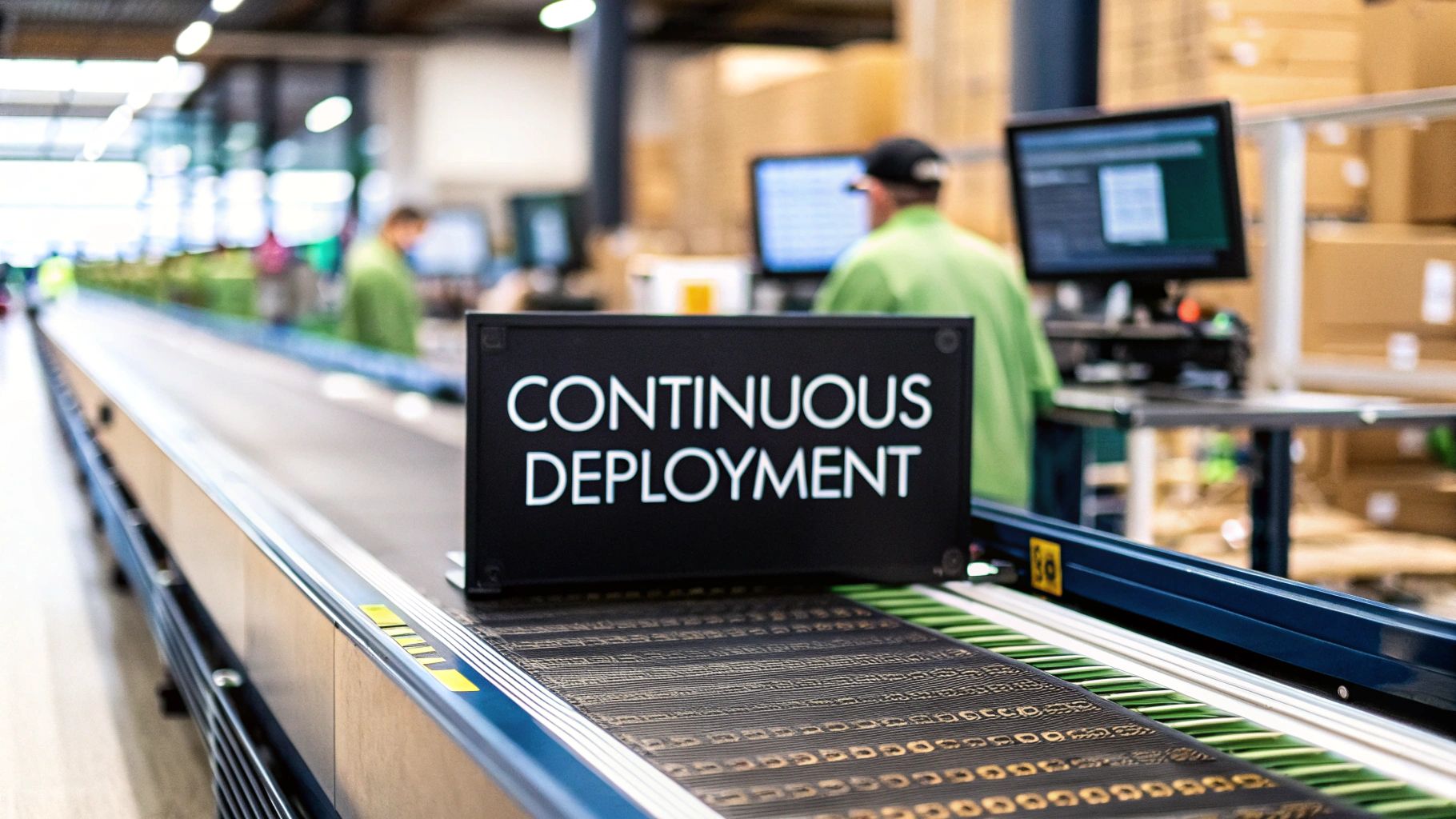
Continuous deployment is the advanced software engineering practice of automatically releasing every code change that successfully passes a series of automated tests directly into the production environment. It represents a fully automated software release process, a significant step beyond continuous delivery, by eliminating all manual intervention and ensuring that new features, bug fixes, and critical updates reach users as quickly and safely as possible. This sophisticated approach dramatically shortens feedback loops, reduces risk, and accelerates an organization's time-to-market.
What Is Continuous Deployment, Really?
Imagine a highly advanced, fully automated bottling plant. As each individual bottle gets filled and capped, it instantly zips through a comprehensive series of automated quality control checks. If it passes every single one—the fill level is perfect down to the milliliter, the cap is hermetically sealed, the label is aligned with pinpoint accuracy—it’s immediately loaded onto a delivery truck. There’s no human manager standing at the end of the line giving a final thumbs-up for each batch. This seamless, hands-off process is the physical-world equivalent of continuous deployment.
In the software development landscape, this represents the pinnacle of automation. It's the final, crucial step in a mature CI/CD (Continuous Integration/Continuous Delivery) pipeline, where every single code change that survives the rigorous gauntlet of automated tests goes live to users without anyone needing to press a "deploy" button. This methodology completely transforms the software release cycle, moving development teams away from large, infrequent, and nerve-wracking release days toward a constant, smooth, and predictable flow of small, incremental improvements.

From Code to Customer in Minutes
At its core, continuous deployment is fundamentally about closing the gap between a developer committing a line of code and a customer deriving value from that change. For product teams, especially startups and scale-ups aiming to find product-market fit or out-innovate competitors, this incredible speed is a massive strategic advantage. It empowers them to test new features, validate hypotheses, and gather real-world data almost instantly. The traditional model of bundling changes into weekly, bi-weekly, or even monthly releases becomes obsolete; with a true continuous deployment approach, high-performing teams can deploy multiple times a day, sometimes even dozens of times.
This relentless, yet controlled, pace delivers a cascade of powerful benefits:
- Faster Feedback Loops: Instead of waiting weeks, you get real-world data on how new features perform and are received within hours. This enables rapid iteration and ensures product development is always aligned with user needs.
- Reduced Deployment Risk: By pushing small, isolated changes, you dramatically lower the "blast radius" of any potential issues. If a bug does occur, it's incredibly easy to pinpoint its source because the change set is tiny and simple to roll back, minimizing user impact.
- Increased Developer Productivity and Morale: Engineers are freed from the tedious, time-consuming, and error-prone rituals of manual deployments. This allows them to focus their energy on what they do best: solving complex problems and building a great product, which leads to higher job satisfaction and innovation.
The Peak of Pipeline Automation
Continuous deployment is truly the final frontier of modern DevOps and a bold commitment to automation where every single code commit that proves its stability is automatically and immediately sent to production. Teams that fully embrace this model have demonstrated remarkable improvements in their development velocity, with lead times for changes becoming up to 200 times faster than with traditional, manual methods. Even more impressively, their change failure rates often drop by 25-50% because of the intense, non-negotiable focus on comprehensive automated testing and quality gates.
This table provides a concise rundown of what continuous deployment really means in practice.
Continuous Deployment At a Glance
| Core Principle | What It Means | Business Impact |
|---|---|---|
| Every Change Is a Release | Any code commit that successfully passes all automated test stages is automatically deployed to the production environment. | Drastically shortens time-to-market for new features and bug fixes, creating a significant competitive advantage. |
| No Manual Gates | Humans are entirely removed from the deployment decision-making process after the initial code commit. The automated pipeline makes the go/no-go call. | Eliminates critical bottlenecks in the release cycle, reduces the potential for human error, and frees up valuable engineering time. |
| High Test Automation | A comprehensive, reliable, and fast suite of automated tests (unit, integration, end-to-end) is an absolute, non-negotiable prerequisite. | Builds deep confidence in the release process, ensures high-quality code reaches users, and acts as the primary safety net. |
| Small, Incremental Updates | The system is designed for and encourages frequent, small commits rather than large, infrequent ones, aligning with agile principles. | Lowers the risk of each individual deployment and simplifies troubleshooting, debugging, and potential rollbacks. |
The rapid adoption of this practice is undeniable. The global continuous delivery market, which is inextricably linked to deployment, was valued at USD 4.92 billion in 2025 and is on an aggressive growth trajectory to hit USD 20.17 billion by 2035, according to detailed market analysis from Precedence Research. This isn't merely a passing trend; it's the definitive direction in which modern, high-performance software development is headed.
Untangling the CI/CD Pipeline
The world of software development is densely packed with acronyms, and it’s remarkably easy to get them mixed up. However, when you look closely, key terms like Continuous Integration (CI), Continuous Delivery, and Continuous Deployment fit together in a clear, logical, and progressive sequence. To truly understand what is continuous deployment, we must first appreciate its specific place within this larger, interconnected automation framework.
Think of the entire process like a high-end restaurant kitchen operating during peak service. Every step, from the initial chopping of vegetables to the final plating of an exquisite dish, builds methodically on the one before it. This meticulously orchestrated flow is exactly how modern automation transforms the traditionally slow, risky, and stressful process of releasing software into a fast, reliable, and predictable engine for business growth.

From Prep Station to the Customer’s Table
Let’s extend that kitchen analogy for a moment. Each distinct part of the CI/CD pipeline has a very specific job to do, much like the different stations in a professional kitchen have their own responsibilities.
Continuous Integration (CI) is the Prep Station. This is where all the individual developers’ work is combined and validated. Developers merge their code changes into a central, shared repository multiple times a day. Just as a disciplined head chef inspects every ingredient for quality, the CI process automatically builds the software and runs a comprehensive battery of unit and integration tests to ensure the new code works as expected and doesn't break any existing functionality. The entire purpose of CI is to find and fix integration problems early, often, and cheaply.
Continuous Delivery is the Plating Station. After the dish is perfectly cooked (meaning the code passes all its automated tests), it’s beautifully arranged on a plate and is ready to be served. It sits under the heat lamp, fully prepared, waiting for a server to give the final "go" to take it out to the customer's table. This represents a crucial manual checkpoint before the final release.
In the software world, Continuous Delivery means that every change that passes the automated tests is automatically deployed to a production-like environment (often called a staging or pre-production environment). The code is always in a deployable state, ready for a human—like a product manager or QA lead—to push the button and release it to users.
- Continuous Deployment is the Automated Conveyor Belt. This is where true, hands-off automation takes complete control. Instead of waiting for a server’s approval, the moment the dish is plated and passes final inspection, it’s placed on an automated conveyor belt that sends it directly to the customer’s table. There are no manual gates, no human intervention, and no waiting.
This is the key differentiator. Continuous Delivery gets your software ready to be released at any time with the push of a button. Continuous Deployment actually releases it for you, automatically, every single time.
Of course, selecting and implementing the right tools makes all the difference in building these sophisticated pipelines. For a closer look at the technologies involved, you can check out our in-depth guide on CI/CD tools comparison.
Comparing CI, Continuous Delivery, and Continuous Deployment
To consolidate these concepts, this table breaks down the key differences between the three core stages of a modern software delivery pipeline.
| Concept | Continuous Integration (CI) | Continuous Delivery | Continuous Deployment |
|---|---|---|---|
| Main Goal | Merge and test code frequently to find and fix integration bugs early in the development cycle. | Ensure every build that passes automated tests is always in a state where it is ready to be released to production. | Automatically release every single passing build directly to the production environment without any human intervention. |
| Automation Ends | After the code is successfully built and has passed its initial suite of automated tests (e.g., unit and integration tests). | After the code is deployed to a staging or pre-production environment, awaiting a manual trigger for the final production release. | After the code is successfully deployed to the live production environment and is accessible to end-users. |
| Manual Step | No manual steps are involved for the integration and basic testing phase. The process is fully automated upon code commit. | Yes. A manual approval step is explicitly required to push the release from the staging environment to production. | No. The entire process from code commit to production deployment is fully automated. This is the defining characteristic. |
| Release Trigger | A developer commits new code to the main development branch, triggering an automated build and test cycle. | A manual decision by a team member (e.g., product manager, QA lead, or release manager) to promote a build to production. | An automated trigger that fires upon the successful completion of all prior pipeline stages, including all automated tests. |
As you can clearly see, each stage represents a deeper and more profound level of automation, with Continuous Deployment standing as the ultimate aspiration for teams looking to maximize their development velocity and deliver value as quickly and safely as possible.
What's the Payoff? The Real-World Business Value of Continuous Deployment
Let's move beyond the technical diagrams and architectural discussions to talk about what this really means for the business. Adopting continuous deployment isn't just a feather in the engineering team's cap or a way to optimize workflows; it fundamentally changes how a company operates, making it more agile, resilient, data-driven, and competitive. The positive impact is felt across the entire organization, from the initial spark of a product idea all the way to the tangible value delivered to your customers.
One of the most significant wins is how dramatically it speeds up your feedback loops. Think about it: instead of waiting weeks or even months to find out if a new feature actually resonates with users, you can get it in front of them in a matter of hours. This near-instantaneous feedback allows you to test ideas, validate critical business assumptions, and pivot your strategy quickly, ensuring you're always building what the market truly wants and not wasting resources on features that don't add value.
Drive Innovation and Reduce Risk
When you are pushing out small, incremental changes automatically and frequently, the immense fear factor associated with a big "release day" completely vanishes. We’ve all been there—those massive, infrequent deployments are incredibly nerve-wracking. A single hidden bug can crash the entire system, leading to frantic, all-hands-on-deck troubleshooting sessions, reputational damage, and lost revenue.
With continuous deployment, if a bug does manage to slip through the comprehensive testing net, you know exactly where to look: the tiny, isolated batch of code that was just deployed. This makes identifying the problem and rolling back the change quick, targeted, and painless, with minimal disruption for your users.
This robust safety net provides your developers with the psychological safety and confidence to experiment and innovate. They can freely try out new things—like A/B testing a new pricing model, tweaking the user interface for better engagement, or integrating a new API—knowing the deployment process is both safe and easily reversible. This freedom from release-day anxiety not only boosts team morale but also empowers engineers to focus their creative energy on generating value instead of just managing deployments.
The Bottom-Line Impact is Real
The business case for this level of automation isn't just theoretical; it's backed by hard numbers and market trends. The entire software world is shifting in this direction, with market forecasts showing massive and sustained growth in this space through 2033. For product leaders and executives, this shift translates directly into measurable returns. A stunning 44% of organizations report seeing a 5x or greater ROI on their automation investments. Some enterprises have even documented savings of over $2.5 million in just three years by eliminating manual operational work and reducing downtime. You can dig into the global continuous deployment software market research to see the full financial picture and growth projections.
When you boil it down, continuous deployment creates a powerful, self-reinforcing positive feedback loop for the entire business:
- Faster Releases: You get valuable features and improvements to your customers sooner, increasing satisfaction and retention.
- Quicker Feedback: You learn from real-world user behavior almost instantly, enabling data-driven product decisions.
- Safer Changes: The risk of a major, system-wide outage plummets, enhancing brand reputation and reliability.
- Happier Teams: Your engineers are empowered and more productive, leading to higher retention rates and a culture of innovation.
This is not just a marginal engineering improvement. It’s a core strategic advantage that can propel the entire business forward in a competitive marketplace.
Building a Foundation for Successful Deployment
Jumping headfirst into continuous deployment without meticulously laying the proper groundwork is a proven recipe for disaster. Think of it like trying to build a skyscraper on a shaky, uneven foundation; the first significant storm that rolls through will bring the entire structure crashing down. Before you can even dream of automating every single release to production, you must build a rock-solid base, encompassing both advanced technical capabilities and a mature organizational culture.
This foundational work isn't just about picking the right set of tools from a list; it’s about fostering a deep sense of trust, discipline, and shared ownership across your entire team. On the technical side, a few key prerequisites are absolutely non-negotiable. Without them, you're not achieving safe, automated releases—you're just automating chaos and pushing bugs to users faster than ever before.

The Technical Prerequisites Checklist
To build an automated pipeline that can confidently push code all the way to production on its own, your team needs to have these key capabilities mastered and dialed in. These aren't just suggestions; they are the fundamental pillars holding up the entire continuous deployment structure.
Comprehensive Automated Testing: Your test suite is your primary safety net, and it needs to be bulletproof. It must be fast, reliable, and provide extensive coverage for everything from tiny, isolated units of code (unit tests) to the complex ways different services and components interact (integration and end-to-end tests). If you can't trust your automated tests 100% of the time, you simply cannot trust an automated pipeline to make deployment decisions for you. This is the most critical technical requirement.
Infrastructure as Code (IaC): Every environment, from a developer's local machine to staging to the live production environment, must be as identical as possible. Using powerful IaC tools like Terraform or Pulumi means your entire infrastructure is defined in code—making it versioned, repeatable, testable, and consistent. This practice finally kills the dreaded "but it worked on my machine" problem and prevents environment-specific bugs from ambushing your releases in production.
Smart Feature Flags: Feature flags (or feature toggles) are a game-changing technique for separating the act of code deployment from the act of feature release. They allow you to push new, unfinished, or experimental code safely to production but keep it hidden from users behind a conditional flag. This gives you the incredible power to test new functionality in the real, live production environment with a small, controlled audience (or just your internal team) before a big rollout, drastically slashing the risk of a bad release. For a deeper dive, review these software deployment best practices that detail more advanced risk-mitigation techniques.
Cultivating a Culture of Ownership
Of course, the best tools and technical practices in the world won't matter if your team's culture isn't ready for this shift. Continuous deployment can only thrive in a very specific type of environment: one built on a foundation of high trust, psychological safety, and shared accountability. When any single code commit can potentially go live to all users within minutes, the developer mindset has to evolve significantly.
The single most critical cultural prerequisite for continuous deployment is a deeply ingrained sense of end-to-end ownership. Development teams must be responsible for their code from the initial idea and implementation all the way through to its performance, stability, and impact in the production environment.
This means developers are no longer just writing code and tossing it over the wall to a separate QA or operations team. They are actively monitoring its impact through observability tools, responding to alerts when things go wrong, and learning directly from user feedback. This creates a tight, powerful feedback loop that naturally drives up code quality, system resilience, and product innovation.
For smaller teams, especially those without dedicated DevOps engineers or security professionals, this level of responsibility can feel daunting. This is precisely where a strategic partner can be invaluable, providing the deep expertise, tooling, and operational guardrails needed to adopt these advanced practices safely and effectively.
How AI Is Shaping the Future of Deployment
Artificial intelligence and continuous deployment are no longer separate, parallel conversations in the tech world. We're witnessing a powerful convergence where they come together to create a software release pipeline that's not just automated, but truly intelligent, predictive, and capable of optimizing itself. This isn't just about doing the same things faster; it's about building a system with a degree of autonomy and foresight that was previously unattainable.
Think about it: modern AI agents are now sophisticated enough to write their own unit tests based on code changes, hunt for subtle performance regressions or security flaws, and even forecast the potential risk of a new release before it even begins its journey through the pipeline. This represents a massive leap forward from traditional methods. Instead of merely reacting to failed tests, we now have an intelligent filter that can proactively catch complex bugs and security vulnerabilities that old-school static analysis tools would likely miss.
Intelligent Monitoring and MLOps
This infusion of intelligence extends right into the live production environment. Modern AI-driven observability and monitoring tools do far more than just send a simple alert when a server's CPU usage spikes. They can analyze millions of data points to spot tiny, almost invisible performance dips, correlate them with a recent deployment, and automatically trigger a rollback if a new update is subtly degrading the user experience—often before a single customer support ticket is filed.
This potent blend of AI and automation isn't some far-off, futuristic concept anymore; it's a real-world competitive advantage available today. For any team working on AI-powered products, a solid Continuous Deployment (CD) pipeline is the very heart of their MLOps (Machine Learning Operations) strategy, giving them the power to iterate on and deploy new machine learning models quickly and reliably enough to keep up with the rapid pace of innovation.
The conversation around what is continuous deployment is gaining significant momentum precisely because of the ongoing AI boom. The global market for AI agents is projected to reach an astonishing USD 10.9 billion by 2026, which tells you everything you need to know about where the industry is heading. We're also seeing AI-native startups grow five times faster than their traditional SaaS counterparts, largely because they have mastered this rapid, continuous learning and deployment cycle. In fact, up to 40% of tech companies are already experimenting with AI agents that can reduce engineering overhead by 20-30%, making a fully intelligent and automated pipeline feel more within reach than ever. You can dig into more of these fascinating AI adoption statistics to see the trends for yourself.
If you're looking to bring these kinds of advanced, AI-enhanced strategies into your own organization, getting a firm handle on how AI and modern software development intersect is the critical first step. For a closer look at how these complex pieces fit together, check out our comprehensive guide on AI-assisted software development.
Navigating Deployment Risks and Common Pitfalls
The thought of adopting a fully automated release process can be, and often is, a little nerve-wracking. For many organizations, it feels like handing over the keys to a high-performance sports car without any prior driving lessons. The idea that every single validated commit could go live to all users automatically is incredibly powerful, but it naturally brings up some significant questions about managing complexity, ensuring security, and avoiding burnout from the day-to-day strain on the team.
The single biggest fear? A complete loss of control. What happens if a sneaky, complex bug gets past all the meticulously crafted automated tests? How do you prevent a critical security flaw from being pushed straight into production for malicious actors to exploit? These aren’t trivial worries; they’re the real-world challenges that demonstrate why you can't just flip a switch on automation and hope for the best. A successful strategy requires careful planning and robust safeguards.
Proactive Strategies for Safe Automation
Successfully implementing what is continuous deployment is all about building intelligent guardrails and safety nets directly into your automated pipeline. The goal isn't just to move fast—it's to move fast safely. The right strategies and tools are what transform this potentially high-stakes process into something that is not only reliable but also significantly safer than traditional manual releases.
Here are a few practical, industry-proven ways to de-risk your automated deployments:
Progressive Delivery: Instead of a risky "big bang" release where a change hits 100% of your users at once, adopt progressive delivery techniques like canary releases. This is where you roll out the new code to just a small, controlled fraction of users first (e.g., 1% or 5%). You get to watch how it behaves in the real world with real traffic, and if your monitoring tools detect any issues, you can pull it back instantly with almost no one noticing.
Automated Security Scanning: Security cannot be an afterthought or a final step in the process. It must be "shifted left" and integrated directly into your pipeline. By building in tools for Static Application Security Testing (SAST), Dynamic Application Security Testing (DAST), and software composition analysis (SCA), you can automatically scan for common vulnerabilities with every single build. This acts as an automated security gatekeeper, stopping a risky build long before it gets anywhere near your production environment.
Robust Observability: You simply can't fix what you can't see. Having solid observability practices—which go beyond simple monitoring to include detailed logging, distributed tracing, and real-time performance dashboards—is absolutely essential. It provides the clear, granular line of sight you need to spot strange behavior, performance regressions, or error spikes, often before your users even know something is wrong.
True continuous deployment isn’t about trading stability for speed. It’s about building a system so reliable and with so many automated safety checks that speed becomes a natural—and safe—byproduct of a high-quality, mature process.
With the right cultural mindset, a commitment to technical excellence, and the right tools in place, any team can get comfortable with full automation. It's about empowering them to deliver value to customers faster and more frequently, without ever having to cut corners on the security and stability their users depend on.
Frequently Asked Questions
Even when you've got a good grasp of the entire CI/CD pipeline, the idea of implementing true continuous deployment can bring up some very practical and important questions. It represents a major cultural and technical shift in how a team operates, so it's only natural to wonder how it all works in the real world. Let's tackle some of the most common questions head-on.
Is Continuous Deployment a Good Fit for Every Project?
Honestly, no. Continuous deployment is a transformative, game-changing practice for web applications, SaaS products, and mobile services where you can gain a serious competitive edge by iterating fast and getting immediate feedback from real users. If your business model relies on the ability to test, learn, and adapt on the fly, this is absolutely the model you should be striving for.
But it’s not a one-size-fits-all solution. In certain contexts, it's simply not the right tool for the job.
- Heavily Regulated Industries: Think about software for medical devices, avionics, or core financial systems. These domains often have strict, mandatory manual validation and compliance gates that are fundamentally incompatible with fully automated releases.
- Slow Release Cadences: For products like traditional desktop software, video games, or hardware with embedded firmware, updates are naturally far less frequent and often require a coordinated launch. A continuous delivery model, which keeps that critical manual approval step before a release, usually makes much more sense.
The key is to match your deployment strategy to what your specific project, industry, and business goals actually need.
How Do You Handle Database Migrations Without Breaking Everything?
This is a huge—and very valid—concern for any team. A database schema change gone wrong can bring your entire application to a screeching halt, causing significant downtime. The safest and most widely used method to avoid this is known as the "expand and contract" pattern (also called parallel change). It’s all about making the process gradual, non-destructive, and, most importantly, fully reversible at every step.
First, you push out new application code that’s smart enough to work with both the old and the new database schema. This is the "expand" phase. Once that code is running smoothly in production, you can run a separate script to migrate the database schema itself, a process which can be done gradually. Finally, once the migration is complete and verified, you can deploy another application update that cleans up the old code, removing support for the previous schema—this is the "contract" phase. This multi-step dance ensures your application stays online throughout the process and gives you a safe way to back out at any stage if an issue arises.
What's the Big Deal with Feature Flags?
Feature flags (sometimes called feature toggles) are an absolutely essential and life-saving tool in a modern continuous deployment world. Think of them as a remote control for your new features. They are simple conditional statements in your code that allow you to push new code all the way to production but keep the associated feature completely hidden from your users until you're ready.
This powerful technique completely decouples code deployment from the actual feature release. It’s the ultimate safety net and a cornerstone of risk reduction.
With a feature flag in place, you can roll out a new, complex feature to a tiny, controlled group—maybe just your internal QA team, a few key stakeholders, or a small percentage of beta testers—to see how it behaves in the wild under real production load. If something goes sideways or a bug is discovered, you just flip the switch off in your feature flagging tool. The feature disappears instantly for all users, and you didn't have to scramble to perform a stressful, high-risk rollback of the entire deployment. This enables safe testing in production, which is a key tenet of advanced deployment practices.
Ready to turn your ambitious ideas into production-ready products without the operational headache? Vibe Connect combines AI-powered analysis with a team of seasoned delivery experts to manage the hard parts of deployment, scaling, and security. Focus on your vision while we connect it with flawless execution. Learn more at https://vibeconnect.dev.